
If your dental implant feels loose, it does not automatically mean that the implant has failed.
Several different components can move:
- the visible dental crown;
- the abutment connecting the crown to the implant;
- the prosthetic screw;
- or the titanium implant fixture inside the jawbone.
These situations are very different.
A loose crown or abutment screw is primarily a prosthetic or mechanical complication and can often be repaired while the implant itself remains securely integrated in the bone.
A mobile implant fixture is much more concerning because a successfully osseointegrated implant should not move independently within the jawbone.
True implant mobility may indicate:
- failure to achieve osseointegration;
- loss of previously established osseointegration;
- advanced supporting bone loss;
- severe peri-implant disease;
- or, less commonly, structural damage involving the implant.
This article explains how to distinguish a loose implant crown, loose abutment screw and loose dental implant fixture, why each problem occurs, how dentists diagnose the cause and whether the implant can be repaired or needs to be removed.
This guide is for general education and cannot diagnose which component is moving. Avoid repeatedly pushing, twisting or testing the implant yourself. A loose implant restoration should be professionally examined.
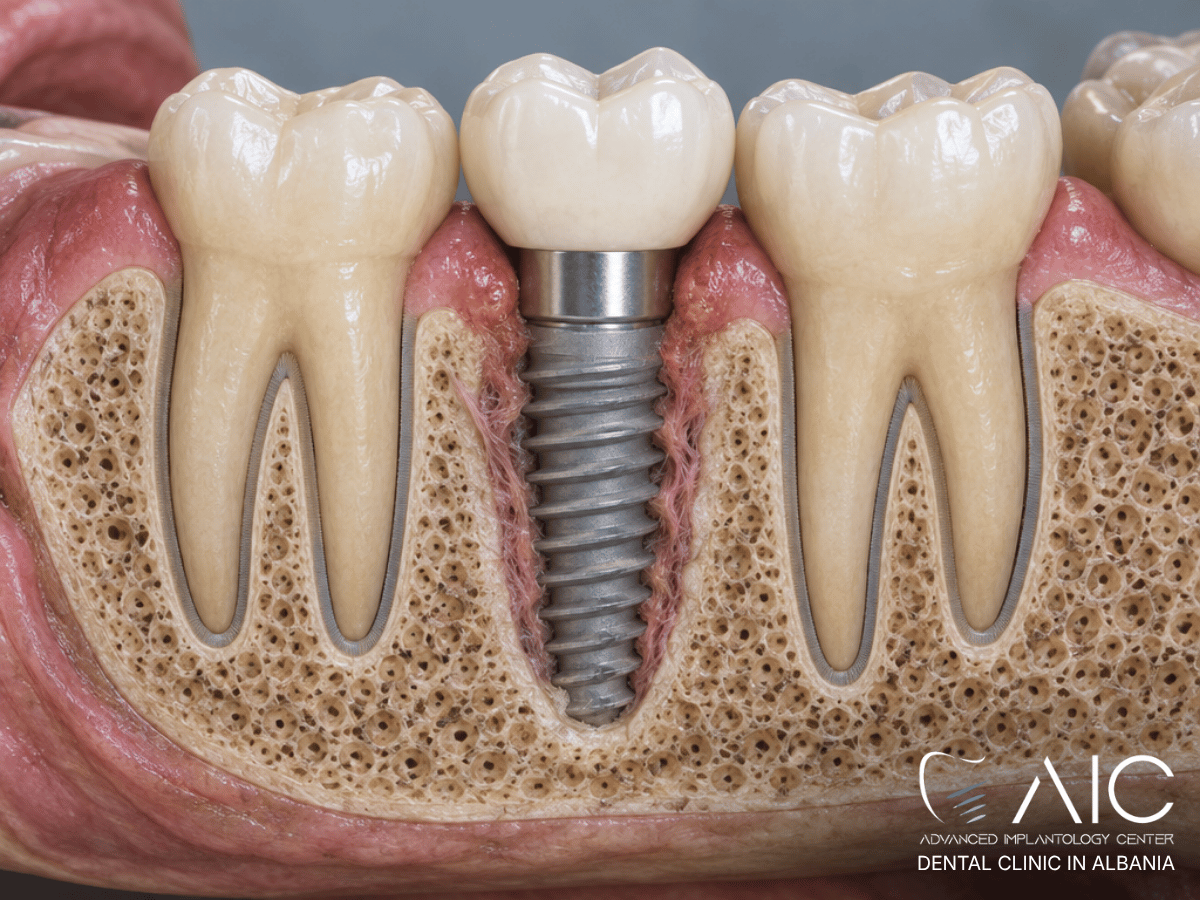
Quick Answer: Why Does My Dental Implant Feel Loose?
If a dental implant feels loose, one of three situations is usually considered first:
- The crown is loose — the restoration above the gum is moving while the implant remains stable.
- The abutment or prosthetic screw is loose — the connection between the restoration and implant has lost stability.
- The implant fixture itself is mobile — the titanium implant is moving within the bone.
The first two are frequently mechanical problems.
The third is a biological or structural problem and usually requires much more serious evaluation.
What Parts Make Up a Dental Implant?
Understanding the components makes it easier to understand why an implant can feel loose.
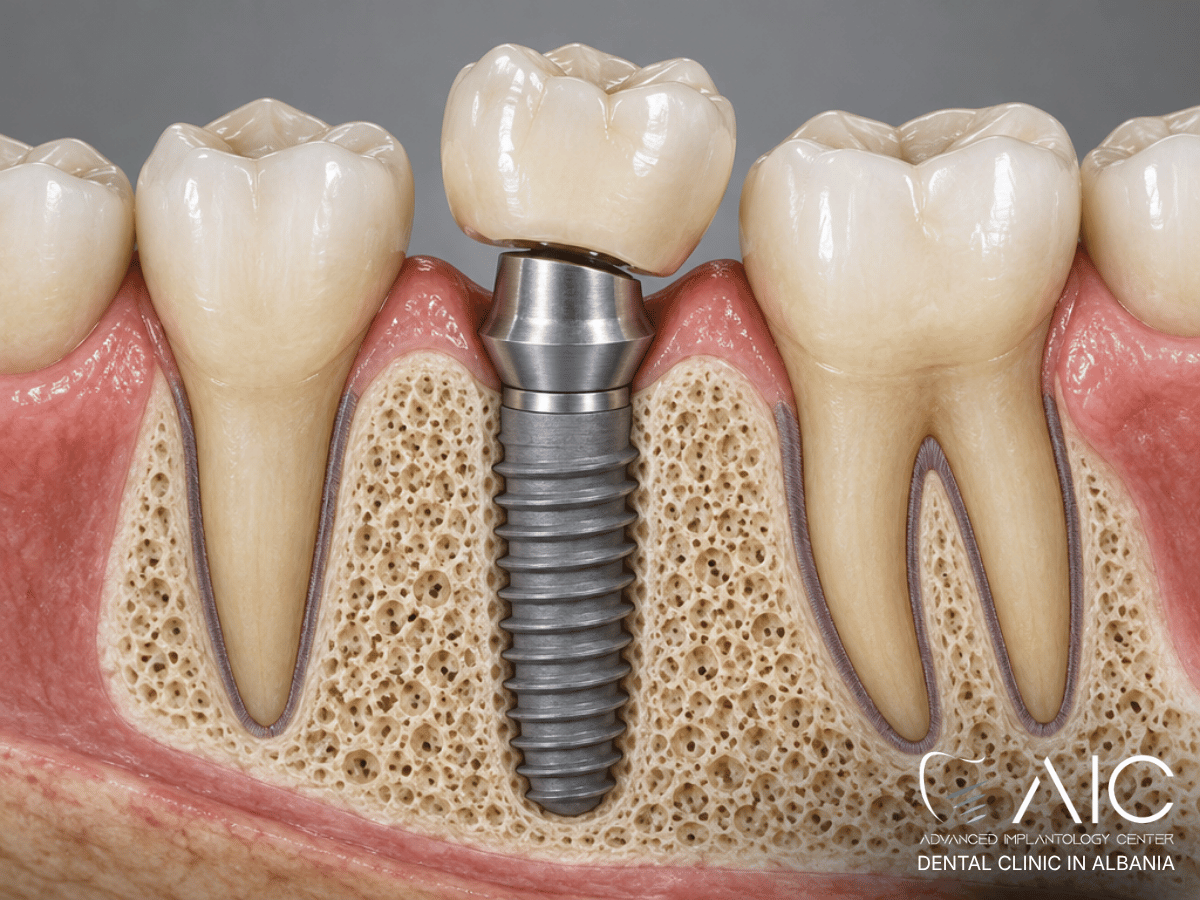
A typical implant-supported single tooth consists of:
1. Implant fixture
This is the titanium component surgically inserted into the jawbone.
After successful healing, bone forms direct contact with the implant surface through a process called osseointegration.
2. Abutment
The abutment connects the implant fixture to the visible restoration.
3. Abutment or prosthetic screw
A small precision screw may secure the abutment or restoration to the implant.
4. Dental crown
This is the visible artificial tooth.
Depending on the restoration, the crown may be screw-retained or cement-retained.
The same principles apply to more complex implant-supported bridges, although several implants and prosthetic components may be connected together.
How Can You Tell What Is Actually Loose?
Patients often describe all movement as “my implant is loose.”
From the patient’s perspective, however, it can be extremely difficult to identify which component is actually moving.
A professional assessment may distinguish between:
| What is moving? | Possible problem | General significance |
|---|---|---|
| Crown only | Loss of cement, crown damage or prosthetic screw problem | Often repairable |
| Crown and abutment | Loose abutment screw or connection problem | Usually prosthetic but needs prompt treatment |
| Entire implant fixture | Loss or absence of osseointegration | Serious implant complication |
| Bridge section | Loose prosthetic screw, fractured component or connection problem | Requires prosthetic assessment |
Do not repeatedly test the restoration with your fingers or tongue.
Continued movement can potentially worsen a loose prosthetic connection and damage screws, components or the restoration.
Loose Implant Crown: What Does It Feel Like?
A loose implant crown may feel as though the artificial tooth:
- rocks slightly;
- clicks when chewing;
- moves when the tongue touches it;
- feels different during biting;
- or seems higher or less stable than before.
The titanium implant beneath the gum may still be completely stable.
Possible causes include:
- loss of cement retention;
- loosening of a prosthetic screw;
- fracture or wear of restorative components;
- or changes in the implant-abutment connection.
Can a Loose Implant Crown Be Fixed?
Often, yes.
The treatment depends on why it has become loose.
The dentist may need to:
- remove the crown;
- inspect the abutment;
- inspect the screw;
- check the implant connection;
- evaluate the bite;
- replace a damaged component;
- retighten according to the implant system’s protocol;
- or remake the crown if necessary.
The important step is confirming that the implant fixture itself remains stable.
What Is a Loose Abutment Screw?
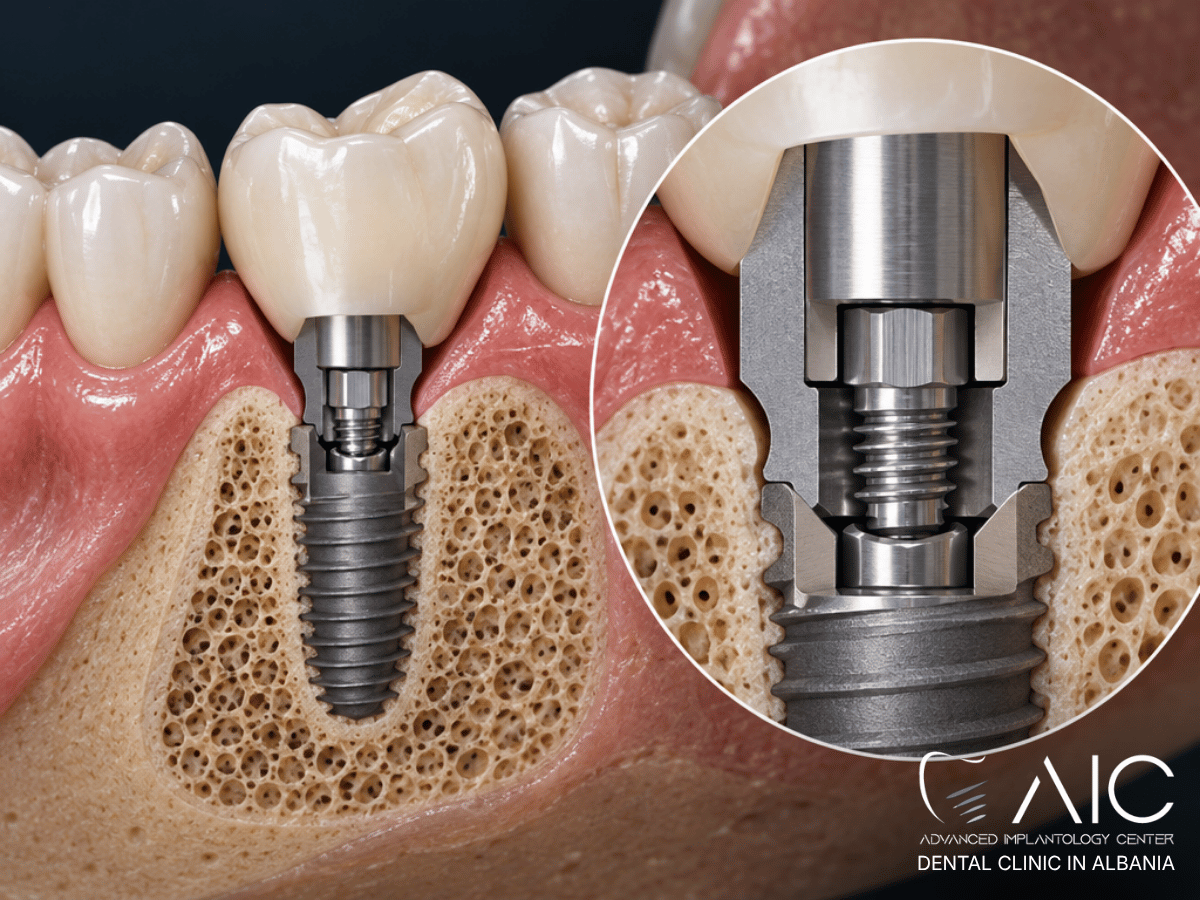
The abutment screw helps create a stable mechanical joint between the implant and the restoration.
When tightened correctly, the screw develops a force known as preload, which helps hold the components together.
Functional forces can gradually affect this connection.
Screw loosening is a recognized technical complication of implant-supported restorations.
Factors associated with screw loosening can include:
- implant-abutment connection design;
- inadequate tightening torque;
- loss of preload;
- settling of contacting surfaces;
- repeated tightening and loosening;
- heavy occlusal forces;
- bruxism or clenching;
- cantilevers;
- prosthetic misfit;
- and unfavorable loading direction.
What Does a Loose Abutment Screw Feel Like?
Possible symptoms include:
- a clicking sensation;
- slight crown movement;
- movement when biting;
- a feeling that the tooth is “wobbly”;
- food trapping around the restoration;
- or discomfort during chewing.
Some patients have no pain at all.
This is why a painless loose implant crown still deserves evaluation.
Why Does an Implant Screw Come Loose?
A screw-retained implant restoration is exposed to thousands of chewing cycles.
Forces acting on the crown can create microscopic movement at the implant-abutment interface.
If forces acting on the joint exceed the clamping force created by screw preload, the screw can gradually lose stability.
Modern implant connections are designed to reduce this risk, but no mechanical connection is completely immune to complications.
Can Bruxism Loosen an Implant Screw?
Bruxism and heavy functional loading can contribute to mechanical complications.
Grinding and clenching may place repeated lateral or non-axial forces on the implant restoration.
Depending on the design of the reconstruction, this can contribute to:
- screw loosening;
- ceramic fracture;
- prosthetic wear;
- screw fracture;
- or other mechanical problems.
If repeated screw loosening occurs, simply tightening the same screw again without identifying the cause may not solve the underlying problem.
What if the Screw Keeps Coming Loose?
Repeated loosening deserves a more complete investigation.
The clinician may evaluate:
- occlusion;
- bruxism;
- implant position;
- crown dimensions;
- cantilever forces;
- connection integrity;
- prosthetic fit;
- screw condition;
- and whether components have been repeatedly reused.
Modern research indicates that repeated tightening and loosening cycles can alter screw-joint mechanics and reduce removal torque over time.
The solution may therefore involve replacing the prosthetic screw or correcting the restoration rather than repeatedly retightening the same component.
Can the Implant Itself Become Loose?
Yes, but this is much more serious than a loose crown or screw.
A successfully osseointegrated dental implant should be rigidly anchored to the jawbone.
It does not have a periodontal ligament like a natural tooth.
Natural teeth have microscopic physiological mobility because they are suspended within a periodontal ligament.
An osseointegrated implant does not normally move in this way.
If the titanium fixture itself is clinically mobile, the clinician must consider loss or absence of osseointegration.
What Is Osseointegration?
Osseointegration is the biological process through which living bone establishes direct structural contact with the implant surface.
It allows the implant to become stable enough to support chewing forces.
Implant stability therefore develops through two related processes:
- primary stability — mechanical stability at placement;
- secondary stability — biological stability created as bone heals and remodels around the implant.
If this biological integration never develops, the implant can become mobile during healing.
If integration was previously established but is later lost, mobility may appear years after treatment.
Loose Dental Implant Shortly After Surgery
A loose implant during the early healing phase may indicate that osseointegration has not developed adequately.
Possible contributing factors include:
- insufficient primary stability;
- excessive micromotion during healing;
- premature functional loading;
- infection;
- unfavorable bone conditions;
- surgical factors;
- smoking;
- or interactions between multiple risk factors.
This is different from normal postoperative discomfort.
If you are experiencing pain rather than mobility, see our detailed guide to pain after dental implant surgery.
Loose Dental Implant After Months or Years
An implant that functioned normally for years and later becomes mobile requires investigation.
Potential causes include:
- advanced peri-implantitis;
- severe supporting bone loss;
- loss of osseointegration;
- implant fracture;
- or a mechanical component creating the impression that the fixture itself is moving.
Again, the first step is determining whether the actual titanium implant is mobile or whether only the prosthesis is moving.
Can Peri-Implantitis Make an Implant Loose?
Advanced peri-implantitis can eventually compromise implant stability.
Peri-implantitis involves inflammation around an implant together with progressive loss of supporting bone.
The implant may remain stable for a considerable period while bone is being lost.
Mobility generally represents a much more advanced situation because a substantial amount of supporting osseointegration has been lost.
Possible signs of peri-implant disease include:
- bleeding around the implant;
- pus or discharge;
- gum swelling;
- increasing probing depth;
- recession;
- exposed implant threads;
- bad taste;
- and progressive radiographic bone loss.
Our guide to dental implant infection and peri-implantitis explains these biological complications in more detail.
Does Bone Loss Automatically Mean the Implant Is Loose?
No.
An implant can lose some supporting bone while still remaining clinically stable.
Peri-implantitis can therefore exist before the implant becomes mobile.
This distinction matters because a stable implant affected by peri-implantitis may sometimes be treated and maintained.
An implant that is genuinely mobile because osseointegration has been completely lost has a very different prognosis.
How Much Bone Loss Is Too Much?
There is no single bone-loss percentage that determines treatment in every patient.
The decision to maintain or remove an implant depends on factors such as:
- implant mobility;
- amount and pattern of remaining bone;
- defect morphology;
- implant position;
- prosthetic design;
- cleanability;
- presence of infection;
- number of affected implants;
- and the patient’s overall risk profile.
Recent reviews suggest that implants affected by peri-implantitis with very extensive supporting bone loss have a poor prognosis, particularly when more than approximately half of the implant support has been lost.
However, bone loss should not be used as the only criterion.
Mobility caused by complete loss of osseointegration is a much clearer indication that the fixture cannot simply be tightened back into the bone.
Can a Loose Implant Be Tightened?
This depends completely on what is loose.
If the prosthetic screw is loose
The dentist may be able to access the connection, inspect it, replace or retighten the appropriate component and correct the cause.
If the crown is loose
The crown may be recemented, repaired, refitted or replaced depending on the problem.
If the titanium implant fixture is loose
The implant itself cannot simply be “tightened” back into healed jawbone.
If true mobility is caused by failed osseointegration, removal is commonly necessary.
Can You Tighten a Dental Implant at Home?
No.
Do not attempt to:
- twist the crown;
- tighten anything with household tools;
- push the implant back into position;
- apply glue;
- use temporary dental cement without professional advice;
- or repeatedly test how far it moves.
Implant screws require the correct driver, component identification and manufacturer-specific torque.
Incorrect manipulation can damage:
- the screw;
- implant threads;
- abutment;
- crown;
- or internal implant connection.
Should You Keep Chewing on a Loose Implant?
It is better to avoid chewing directly on a loose implant restoration until it has been assessed.
Continuing to load a loose connection may increase movement and potentially cause:
- screw damage;
- screw fracture;
- damage to the crown;
- wear of the connection;
- or irritation of surrounding tissues.
Choose softer foods and use the opposite side when possible until you receive professional advice.
Can a Loose Dental Implant Cause Pain?
Yes, but a loose restoration can also be completely painless.
Possible discomfort may come from:
- movement of the crown against the gum;
- food trapping;
- inflamed peri-implant tissues;
- occlusal overload;
- peri-implantitis;
- or damage to prosthetic components.
Pain does not identify which component is loose.
Loose Implant With No Pain: Is It Still a Problem?
Yes.
A mechanical complication does not need to hurt.
Many loose screws and crowns produce movement before significant discomfort appears.
Similarly, peri-implant disease can progress with limited pain.
Do not wait for severe symptoms before arranging an assessment.
Clicking Dental Implant When Chewing
A clicking sensation can suggest movement between prosthetic components.
Possible causes include:
- a loose screw;
- a moving crown;
- a poorly fitting restoration;
- or another prosthetic connection problem.
Clicking should be assessed before continued chewing damages components further.
What if the Implant Crown Fell Off Completely?
If the crown or prosthetic component comes off:
- do not attempt to glue it back yourself;
- keep the component clean and safe;
- avoid chewing on the exposed implant area;
- and contact the dental clinic.
The dentist can determine whether the crown, abutment or screw has failed and whether the existing restoration can be reused.
Can Food Get Under a Loose Implant Crown?
Yes.
Movement or loss of fit can create spaces where food and plaque accumulate.
This can cause:
- bad taste;
- odor;
- gum irritation;
- inflammation;
- and difficulty cleaning.
A loose restoration should therefore be repaired even when the underlying implant remains healthy.
How Does a Dentist Diagnose a Loose Implant?
The first goal is to identify exactly where the movement originates.
The examination may include:
- patient history;
- when the movement started;
- checking the crown and bridge;
- evaluation of prosthetic screws;
- assessment of implant fixture stability;
- occlusal analysis;
- peri-implant probing when appropriate;
- checking for bleeding or suppuration;
- and radiographic evaluation.
The clinician may need to remove or access the prosthetic restoration to isolate the individual components.
Will an X-Ray Show Why the Implant Is Loose?
Radiographs can provide important information, but they are only one part of the diagnosis.
They may reveal:
- marginal bone loss;
- peri-implant bone defects;
- a radiolucent interface around a failed implant;
- fractured components in some cases;
- or changes compared with previous imaging.
However, a loose screw may not create an obvious abnormality on a standard dental X-ray.
Clinical examination therefore remains essential.
Does a CBCT Scan Help?
CBCT provides three-dimensional information about bone and surrounding anatomy.
It may be useful in selected cases when the dentist needs to assess:
- complex bone loss;
- buccal or lingual bone defects;
- implant position;
- relationship with anatomical structures;
- or planning after implant removal.
It is not automatically necessary for every loose crown or screw.
What Is Resonance Frequency Analysis?
Implant stability can sometimes be assessed using non-invasive technologies such as resonance frequency analysis.
These methods provide indirect information about implant stability.
They do not directly measure every aspect of bone-to-implant contact and must be interpreted together with the clinical examination and imaging.
Can a Loose Dental Implant Be Saved?
The answer depends entirely on the cause.
| Problem | Can it often be saved? |
|---|---|
| Loose crown | Often yes |
| Loose prosthetic screw | Often yes |
| Damaged abutment | Often repairable or replaceable |
| Early peri-implantitis with stable fixture | Potentially, depending on severity |
| Advanced bone loss but stable fixture | Case dependent |
| Mobile implant fixture from lost osseointegration | Usually requires removal |
| Fractured implant fixture | Often requires removal |
When Does a Loose Implant Need to Be Removed?
Removal may be necessary when:
- the implant fixture itself is mobile;
- osseointegration has failed;
- there is extensive progressive bone loss with poor prognosis;
- the implant is fractured;
- its position makes predictable restoration impossible;
- or advanced disease cannot reasonably be controlled.
Recent evidence on implant removal emphasizes that mobility resulting from complete loss of osseointegration is a strong indication for explantation.
What Happens After a Failed Implant Is Removed?
Removal does not automatically mean that another implant can never be placed.
The treatment sequence may include:
- removing the failed implant;
- cleaning the site;
- identifying why the implant failed;
- assessing remaining bone;
- allowing healing when necessary;
- reconstructing deficient bone;
- and considering a new implant at a later stage.
If substantial bone has been lost, bone grafting for implants may be considered before or during retreatment.
Can Another Implant Be Placed in the Same Site?
Often, yes, but not automatically.
The clinician first needs to determine why the original implant failed.
Important factors include:
- remaining bone;
- infection;
- implant position;
- smoking;
- diabetes;
- periodontal history;
- prosthetic loading;
- and the condition of neighboring structures.
In some cases, a new implant can be placed immediately after removal.
In others, healing or bone regeneration should occur first.
Why You Should Find the Cause Before Replacing a Loose Implant
Replacing the implant without understanding why the first one failed risks repeating the same problem.
A new treatment plan should investigate:
- biological factors;
- mechanical loading;
- bone quality;
- implant position;
- infection;
- prosthetic design;
- hygiene access;
- and systemic risk factors.
How Can Screw Loosening Be Prevented?
Not every prosthetic complication can be prevented, but good implant prosthodontics can reduce risk.
Important factors include:
- appropriate implant-abutment connection;
- correct component selection;
- manufacturer-recommended tightening torque;
- accurate prosthetic fit;
- appropriate crown dimensions;
- controlled occlusion;
- management of bruxism;
- and regular follow-up.
Implant-supported restorations should also be designed so that they can be professionally inspected and maintained.
Can a Loose Screw Damage the Implant if Ignored?
Potentially.
Continued functional loading of a loose connection may contribute to:
- wear of the screw joint;
- damage to prosthetic components;
- screw fracture;
- restoration fracture;
- micro-movement;
- and difficulty retrieving damaged components.
For this reason, early assessment is preferable to waiting until the restoration fails completely.
Is a Loose Implant an Emergency?
A loose implant restoration does not usually represent a life-threatening medical emergency, but it should be evaluated promptly.
If the titanium fixture itself appears mobile, avoid chewing on it and arrange an implant assessment as soon as possible.
More urgent medical attention may be required if movement is accompanied by:
- rapidly increasing facial swelling;
- fever and significant systemic illness;
- difficulty swallowing;
- difficulty breathing;
- or uncontrolled bleeding.
What Should I Do Until My Appointment?
If your implant crown or restoration feels loose:
- avoid chewing hard foods on that side;
- do not twist or repeatedly test it;
- do not attempt to tighten it yourself;
- do not glue the restoration;
- keep the area gently clean;
- and arrange a professional assessment.
If a component falls out completely, keep it somewhere clean and bring it to the appointment.
Frequently Asked Questions About Loose Dental Implants
Why does my dental implant feel loose?
The movement may come from the crown, abutment screw or titanium implant fixture itself. These problems require different treatments, so professional examination is needed to determine what is actually moving.
Can a dental implant crown come loose while the implant stays stable?
Yes. A crown, abutment or prosthetic screw can move even when the titanium implant remains securely osseointegrated in the bone.
Is a loose implant screw serious?
It is usually less serious than mobility of the implant fixture, but it should not be ignored. Continued movement can damage prosthetic components or the implant connection.
Can the screw simply be tightened?
Sometimes, but the clinician should first determine why it loosened and inspect the screw, connection, restoration and bite. Repeatedly retightening a problematic screw without addressing the cause may lead to recurrence.
Can I tighten my dental implant myself?
No. Implant components require system-specific instruments and controlled torque. Home tightening can damage the restoration or internal implant connection.
Is a wobbly dental implant always a failed implant?
No. Patients frequently perceive a loose crown or screw as a loose implant. If the titanium fixture itself is mobile, however, failure of osseointegration becomes a major concern.
What does a failed implant feel like?
Possible signs include fixture mobility, discomfort during chewing, progressive bone loss, inflammation or infection. Some failed implants may have limited pain, so mobility is particularly important.
Can an implant move slightly like a natural tooth?
A natural tooth has a periodontal ligament and therefore has slight physiological mobility. A successfully osseointegrated implant does not have a periodontal ligament and should not demonstrate comparable clinical movement.
Can peri-implantitis make an implant loose?
Yes, if enough supporting bone and osseointegration are lost. Earlier peri-implantitis may occur while the implant is still clinically stable.
Can a loose implant be saved?
A loose crown, screw or abutment can often be repaired. A genuinely mobile fixture caused by complete loss of osseointegration usually has a much poorer prognosis and often requires removal.
Why does my implant click when I chew?
Clicking can indicate movement between prosthetic components, such as a loose screw or crown. Stop loading the area heavily and have the restoration examined.
Why is my dental implant loose after several years?
Possible causes include prosthetic screw loosening, crown problems, peri-implantitis, advanced bone loss, structural complications or loss of osseointegration.
Can a dental implant become loose without pain?
Yes. Both prosthetic complications and biological problems may initially produce little or no pain.
Will an X-ray show a loose implant screw?
Not necessarily. Radiographs can evaluate bone and some structural problems, but a loose screw is often identified through clinical and prosthetic examination.
Can I keep chewing on a loose implant?
It is better to avoid loading the area until it has been assessed because continued movement may damage the screw, crown or other components.
Can a failed implant be replaced?
Often yes. The site must first be evaluated for bone loss, infection and the original cause of failure. Bone grafting or a healing period may sometimes be required.
Loose Dental Implant: The Bottom Line
If your dental implant feels loose, the most important question is not simply “Is my implant failing?”
It is:
“Which component is actually moving?”
A dental implant restoration contains multiple components, and movement can originate from:
- the crown;
- the abutment;
- the prosthetic screw;
- or the implant fixture itself.
A loose crown or screw can often be repaired while preserving the osseointegrated implant.
Mobility of the titanium implant itself is different.
A properly osseointegrated implant should be rigidly stable in the jawbone. True fixture mobility suggests that osseointegration has failed or has been lost and usually requires a more extensive treatment plan.
The safest approach is therefore to:
- stop repeatedly testing the implant;
- avoid hard chewing on the area;
- have the crown and prosthetic connection inspected;
- assess implant stability;
- evaluate supporting bone and peri-implant tissues;
- and treat the actual cause rather than simply tightening whatever appears loose.
At SOTA Dental – Advanced Implantology Center, implant complications can be evaluated through clinical examination, prosthetic assessment and diagnostic imaging to determine whether the problem involves the restoration, screw, supporting tissues or implant fixture.
If you are researching implant treatment generally, see our dental implant treatment options. Patients with implant-supported restorations can also learn more about implant-supported bridges.
Medical disclaimer: This article provides general educational information and does not diagnose a loose dental implant. If an implant restoration or fixture is moving, arrange a professional dental assessment rather than attempting to tighten or repair it yourself.