
If you have been told that you do not have enough upper-jaw bone for conventional dental implants, there may be more than one way to rebuild fixed teeth.
Two of the most advanced options are:
- rebuilding the deficient jaw with bone grafting and then placing conventional implants;
- or bypassing severely resorbed maxillary bone with zygomatic implants anchored in the cheekbone.
These treatments solve the same fundamental problem in completely different ways.
Bone grafting creates or increases bone where conventional implants need to be placed.
Zygomatic implants use a different anatomical anchor. Instead of depending primarily on the severely resorbed posterior upper jaw, these extra-long implants extend toward and obtain anchorage in the zygomatic bone.
This can make fixed implant rehabilitation possible in selected patients with extreme maxillary atrophy who would otherwise require major reconstructive surgery.
However, this does not mean zygomatic implants are automatically “better” than bone grafting.
They involve:
- a different surgical technique;
- greater anatomical complexity;
- specialized surgical training;
- different complications;
- and a different approach to long-term maintenance.
The choice should therefore be based on your anatomy, sinus health, remaining maxillary bone, medical condition, previous treatment history and the type of prosthesis being planned.
This guide compares bone graft vs zygomatic implants for severe upper-jaw bone loss, including treatment time, surgery, healing, risks, implant survival, immediate loading and which type of patient may benefit from each approach.
This article is for general education. Severe maxillary atrophy should be evaluated using clinical examination and three-dimensional imaging by a clinician experienced in advanced implant rehabilitation.
Quick Answer: Bone Graft or Zygomatic Implants?
There is no single option that is best for every patient.
Bone grafting may be preferable when:
- the missing bone can be predictably reconstructed;
- the patient is suitable for staged treatment;
- conventional implant positions can be restored after augmentation;
- and the additional healing time is acceptable.
Zygomatic implants may be considered when:
- the upper jaw is extremely resorbed;
- conventional posterior implants cannot obtain adequate anchorage;
- major bone reconstruction would otherwise be required;
- previous grafting has failed in selected cases;
- or avoiding extensive graft-based reconstruction offers a meaningful clinical advantage.
Modern consensus recommendations emphasize individualized treatment planning rather than automatically choosing the most aggressive technique.
What Is Severe Upper Jaw Bone Loss?
The upper jaw is called the maxilla.
When teeth are lost, the alveolar bone that previously supported them gradually remodels and can decrease in:
- height;
- width;
- and overall volume.
The posterior upper jaw presents an additional challenge because the maxillary sinus occupies much of the area above the molar and premolar teeth.
Over time, a patient may therefore develop:
- a thin alveolar ridge;
- very little vertical bone beneath the sinus;
- horizontal ridge deficiency;
- combined vertical and horizontal loss;
- or extensive full-arch maxillary atrophy.
Previous severe periodontitis can accelerate this destruction.
Other causes can include:
- long-term tooth loss;
- trauma;
- failed implants;
- previous infections;
- multiple surgeries;
- congenital defects;
- and surgical removal of part of the maxilla.
Why Does Severe Bone Loss Make Conventional Implants Difficult?
A conventional dental implant requires enough bone in an appropriate three-dimensional position to provide:
- initial mechanical stability;
- space around the implant;
- long-term osseointegration;
- and a prosthetically appropriate implant position.
If the ridge is extremely thin or short, simply placing a conventional implant into the remaining bone may create:
- poor primary stability;
- implant exposure;
- an unfavorable implant angle;
- sinus penetration;
- poor prosthetic positioning;
- or inability to place the implant at all.
The treatment plan therefore needs either to increase the available bone or use another anatomical region for anchorage.
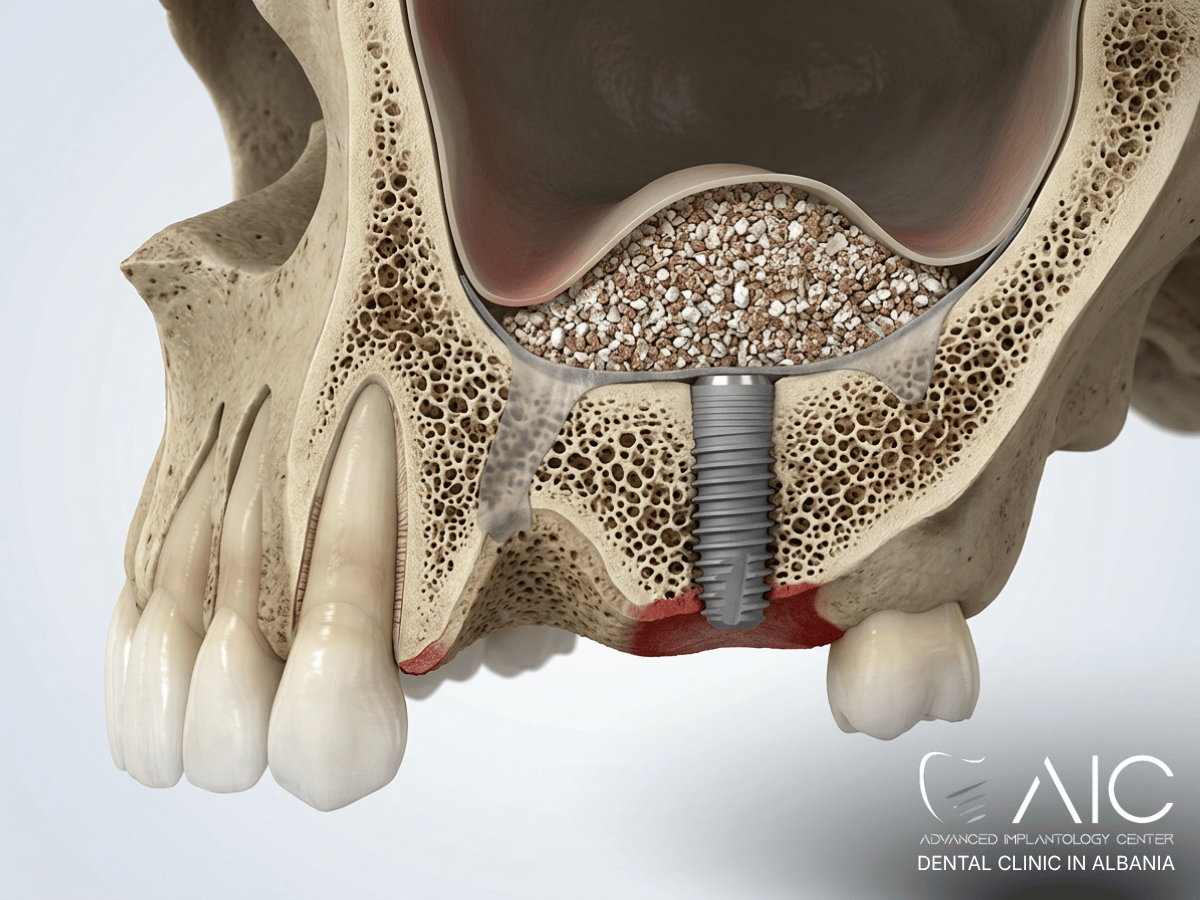
What Is Bone Grafting for Dental Implants?
Bone grafting is a broad term covering procedures used to increase available bone before or during implant treatment.
Depending on the defect, reconstruction may include:
- guided bone regeneration;
- particulate bone grafting;
- block grafting;
- ridge augmentation;
- maxillary sinus floor elevation;
- or combinations of these techniques.
The objective is to create a sufficient volume of stable bone so that conventional dental implants can be placed in an appropriate position.
Learn more about bone grafting for dental implants.
Where Does Bone Graft Material Come From?
Depending on the procedure, grafting materials can include:
- the patient’s own bone;
- processed donor-derived material;
- animal-derived graft material;
- synthetic bone substitutes;
- or combinations of these materials.
Large reconstructive defects may require a very different approach from a small localized defect around one implant.
What Is a Sinus Lift?
A sinus lift is one type of augmentation used when there is insufficient vertical bone beneath the maxillary sinus.
The sinus membrane is carefully elevated and additional space is created for new supporting bone.
Sinus augmentation can be highly effective when some native posterior maxillary bone remains.
However, extremely severe maxillary atrophy can require more extensive reconstruction than a standard sinus lift alone.
What Are Zygomatic Implants?
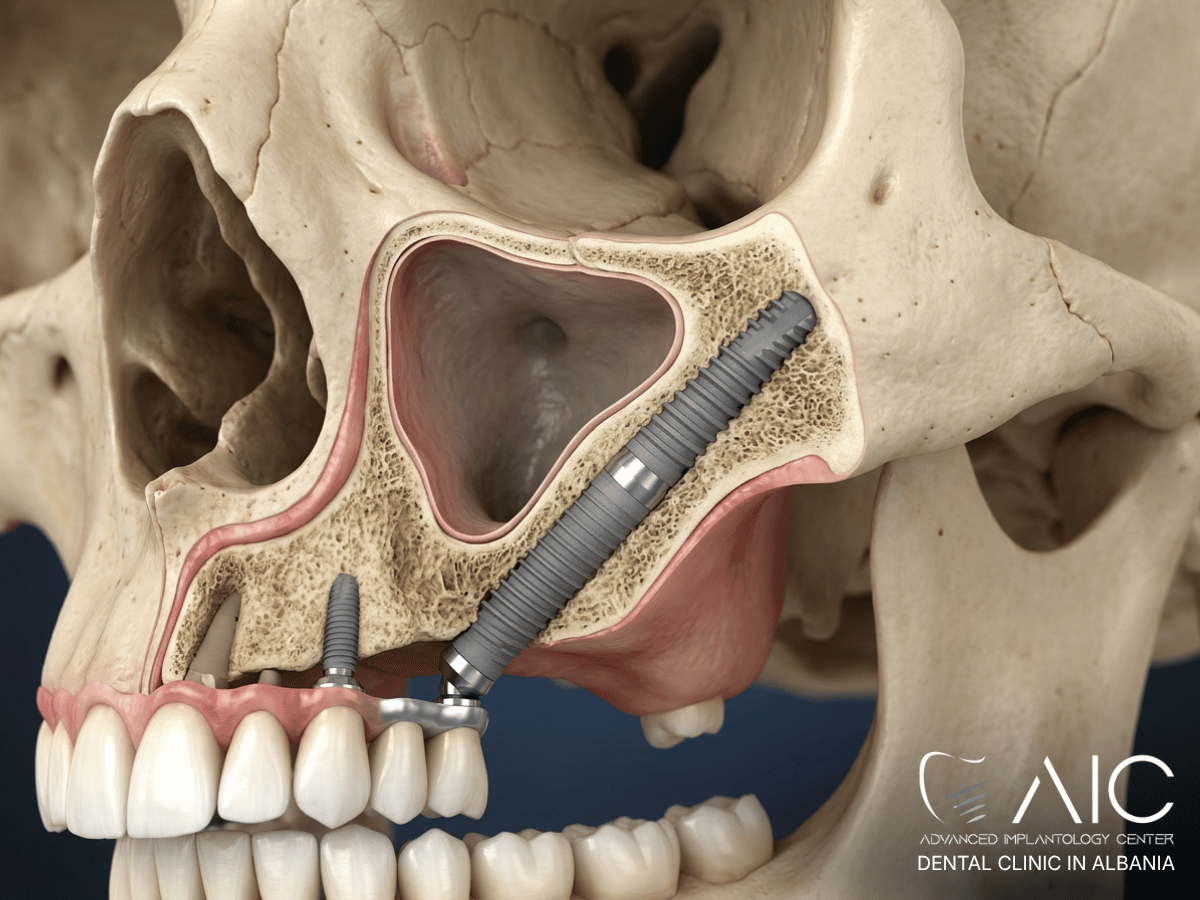
Zygomatic implants are extra-long dental implants used primarily for reconstruction of the severely atrophic upper jaw.
Instead of relying entirely on the deficient posterior maxillary alveolar bone, the implant obtains strong anchorage in the zygomatic bone — the cheekbone.
The implant travels from the oral cavity through or alongside the severely resorbed maxillary region toward the zygoma.
This is fundamentally different from an ordinary implant.
Zygomatic implants are therefore not simply “long normal implants.”
They require detailed understanding of:
- zygomatic anatomy;
- the maxillary sinus;
- the orbit;
- facial structures;
- three-dimensional implant trajectories;
- and full-arch prosthetic biomechanics.
Are Zygomatic Implants Only for the Upper Jaw?
Yes. Zygomatic implants are specifically associated with treatment of severe maxillary — upper-jaw — deficiency.
The zygomatic bone does not provide an equivalent treatment concept for severe lower-jaw atrophy.
Patients with significant mandibular bone loss require different reconstructive or implant strategies.
Why Are Zygomatic Implants Used?
The 2023 International Team for Implantology consensus report identified severe maxillary bone atrophy or deficiency as the principal indication for zygomatic implant therapy.
Potential scenarios include:
- extremely resorbed completely edentulous maxillae;
- severe posterior maxillary deficiency;
- patients who would otherwise require extensive bone reconstruction;
- certain failed grafting situations;
- and selected maxillary defects following surgical resection.
However, there is no single universally accepted millimeter threshold that automatically means a patient needs zygomatic implants.
Three-dimensional anatomy and prosthetic planning are more important than one isolated measurement.
Zygomatic Implants vs Bone Graft: The Fundamental Difference
| Bone Grafting | Zygomatic Implants |
|---|---|
| Reconstructs missing maxillary bone | Bypasses severely deficient posterior maxillary bone |
| Usually supports conventional implants | Uses extra-long implants anchored in the zygomatic bone |
| May require staged healing | Can sometimes support immediate fixed rehabilitation |
| Graft integration must occur | Can reduce or eliminate major graft requirements in selected cases |
| Complications depend on graft type and donor site | Complications include sinus and other anatomically specific risks |
| Widely used across many types of bone defects | Reserved primarily for advanced maxillary deficiency |
Do Zygomatic Implants Avoid Bone Grafting Completely?
Sometimes, but not always.
One major advantage of zygomatic implants is the possibility of avoiding extensive graft-based reconstruction.
However, saying that zygomatic treatment always means “zero bone graft” is too simplistic.
The treatment may still involve:
- minor localized grafting;
- soft-tissue procedures;
- conventional implants in areas where bone remains;
- or other reconstructive steps.
The appropriate combination depends on the patient’s anatomy.
What Is the Classic Zygomatic Implant Concept?
When sufficient anterior maxillary bone remains, a full-arch restoration may combine:
- zygomatic implants posteriorly;
- and conventional implants anteriorly.
The implants are connected by a rigid full-arch prosthesis.
This distributes functional forces across multiple anchorage points.
What Is Quad Zygoma?
In extreme maxillary atrophy where even the anterior maxilla cannot reliably support conventional implants, some specialized protocols use two zygomatic implants on each side.
This is often called quad zygoma.
Quad zygoma is one of the most advanced forms of implant rehabilitation and should be reserved for carefully selected patients treated by highly experienced teams.
Can Zygomatic Implants Provide Fixed Teeth Immediately?
In selected cases, yes.
Zygomatic implants often achieve strong initial anchorage in dense zygomatic bone.
When:
- primary stability is adequate;
- the implants are appropriately distributed;
- the prosthesis is rigidly splinted;
- and the clinical situation is suitable,
an immediate provisional fixed bridge may sometimes be delivered.
However:
“zygomatic implant” does not automatically mean “fixed teeth in one day.”
Immediate loading is a clinical decision based on stability, surgical findings and prosthetic conditions.
How Long Does Bone Grafting Take?
Bone-graft treatment timelines vary enormously.
A small simultaneous graft performed during implant placement may add little additional treatment time.
Major maxillary reconstruction may require:
- bone augmentation;
- several months of graft healing;
- implant placement;
- another osseointegration period;
- and final prosthetic rehabilitation.
In complex staged reconstruction, the complete process can therefore take many months.
Are Zygomatic Implants Faster Than Bone Grafting?
They can be dramatically faster in appropriately selected severe-atrophy cases.
The most recent Cochrane review, published in 2026, identified one randomized comparison between zygomatic implants with immediate loading and conventional implants placed after bone augmentation.
In that particular trial, mean time to rehabilitation was approximately:
- 1.3 days with the zygomatic protocol;
- versus 444 days with the graft-based protocol.
This difference demonstrates the potential treatment-time advantage of zygomatic rehabilitation.
However, it should not be interpreted as meaning that every bone-graft case requires 444 days or every zygomatic case receives teeth in 1.3 days.
Those figures came from one specific randomized trial using specific treatment protocols.
Which Option Has Better Implant Survival?
Both approaches can achieve high implant survival when performed in appropriate patients.
The 2023 ITI consensus report analyzed long-term zygomatic implant data and reported an estimated mean survival of approximately 96.2% over a mean follow-up of approximately 6.3 years.
Another long-term systematic review comparing zygomatic and conventional implants reported mean survival rates of approximately:
- 96.5% for zygomatic implants;
- and 95.8% for conventional implants
over long-term follow-up, without a significant difference between them.
These values demonstrate that zygomatic implants can achieve high survival.
But implant survival is only one part of treatment success.
Implant Survival Is Not the Same as Complication-Free Treatment
An implant can remain in place while the patient experiences:
- sinus problems;
- soft-tissue complications;
- prosthetic problems;
- cleaning difficulties;
- or the need for additional treatment.
This is particularly important when discussing zygomatic implants.
High implant survival should not be interpreted as a guarantee of complication-free treatment.
What Did the 2026 Cochrane Review Find?
The 2026 Cochrane review is especially valuable because it directly evaluated zygomatic treatment against conventional implants placed after augmentation.
At three years, the review concluded that zygomatic implants:
- probably reduced time to rehabilitation;
- probably reduced implant failures in the included comparison;
- may have reduced prosthetic failures;
- but probably increased complications.
The comparison included only 71 participants initially, and the authors emphasized that the overall evidence remains limited.
This means it would be inappropriate to claim that zygomatic implants have definitively been proven superior to bone grafting.
Are Zygomatic Implants More Dangerous?
Zygomatic implants involve more complex anatomy than conventional implant placement.
Potential complications reported in the literature include:
- maxillary sinusitis;
- oroantral communication;
- soft-tissue dehiscence;
- infection;
- prosthetic complications;
- altered sensation;
- implant failure;
- and uncommon but potentially serious surgical complications involving nearby facial or orbital anatomy.
This is why zygomatic implant placement is not considered routine implant surgery.
Sinusitis After Zygomatic Implants
Sinus-related disease is one of the best-documented biological complications.
The 2023 ITI consensus report estimated a total sinusitis prevalence of approximately 14.2% over a mean follow-up of approximately 5.5 years in the analyzed literature.
This does not mean that 14.2% of every modern zygomatic implant population will develop sinusitis.
Risk can vary according to:
- surgical technique;
- implant trajectory;
- pre-existing sinus health;
- prosthetic design;
- soft-tissue sealing;
- and patient selection.
Nevertheless, sinus health is an essential part of zygomatic implant assessment.
Do Bone Grafts Have Complications Too?
Yes.
Bone augmentation is not risk-free.
Possible complications include:
- graft exposure;
- membrane exposure;
- infection;
- partial graft resorption;
- graft failure;
- wound dehiscence;
- sinus complications when sinus augmentation is involved;
- and donor-site morbidity when bone is harvested from another location.
Large autogenous grafting procedures can create a second surgical site, increasing overall surgical burden.
Which Surgery Is More Invasive?
This cannot be answered simply.
A small guided bone-regeneration procedure is clearly less invasive than zygomatic implant placement.
However, a patient with extreme maxillary atrophy might otherwise require:
- major block grafting;
- bilateral sinus augmentation;
- large-volume bone reconstruction;
- multiple surgical stages;
- and prolonged healing.
In that context, a graftless or reduced-graft zygomatic strategy may reduce the total number of surgeries even though the individual zygomatic operation is technically more demanding.
Bone Grafting Advantages
Potential advantages include:
- use of conventional implant positions;
- restoration of deficient maxillary anatomy;
- familiar implant-restorative pathways;
- ability to treat localized defects;
- and avoiding the specialized anatomical trajectory of zygomatic implants.
Bone Grafting Disadvantages
Depending on defect severity, disadvantages can include:
- additional surgical procedures;
- longer treatment time;
- graft-healing periods;
- graft resorption;
- donor-site morbidity with autogenous grafts;
- and the possibility that extensive reconstruction may still be insufficient.
Zygomatic Implant Advantages
Potential advantages in carefully selected patients include:
- avoiding major maxillary bone reconstruction;
- using dense zygomatic bone for anchorage;
- shortening total rehabilitation time;
- potential immediate loading;
- fewer staged grafting procedures;
- and providing a fixed solution in some patients previously told that conventional implants were impossible.
Zygomatic Implant Disadvantages
Potential disadvantages include:
- technically demanding surgery;
- requirement for highly experienced clinicians;
- sinus-related complications;
- complex management if a zygomatic implant fails;
- prosthetic complexity;
- and potentially serious anatomical complications if surgical planning or execution is inadequate.
Who May Be Better Suited to Bone Grafting?
Bone reconstruction may be favored when:
- the defect is moderate rather than extreme;
- the required augmentation is predictable;
- conventional implants can ultimately be placed in ideal positions;
- the patient accepts staged treatment;
- sinus anatomy is suitable;
- and the patient is medically suitable for graft surgery.
Who May Be Considered for Zygomatic Implants?
Zygomatic implants may enter the discussion when there is:
- extreme posterior maxillary resorption;
- severe generalized maxillary atrophy;
- insufficient bone for conventional implants despite alternative positioning;
- a need for very extensive grafting to use conventional implants;
- selected previous graft failures;
- or a strong clinical reason to reduce staged reconstructive treatment.
The decision should be made after three-dimensional surgical and prosthetic planning.
Who Should Not Automatically Receive Zygomatic Implants?
A patient should not be directed toward zygomatic implants simply because an X-ray shows “some bone loss.”
Before choosing such an advanced treatment, the clinician should determine whether the patient could instead receive:
- standard-length conventional implants;
- short implants;
- tilted implants;
- a limited sinus augmentation;
- localized guided bone regeneration;
- or another less invasive solution.
The latest 2026 global consensus for the edentulous maxilla specifically emphasizes balancing surgical complexity, prosthetic feasibility and patient-centered treatment planning.
What About Short Implants Instead of Bone Grafting?
Short implants can sometimes avoid sinus augmentation when sufficient residual native bone remains.
This is particularly relevant in the posterior maxilla with limited vertical bone height.
A 2026 meta-analysis of randomized trials found no significant difference in implant failure between short implants and longer implants placed with sinus floor elevation.
This does not mean short implants can replace zygomatic implants in extreme maxillary atrophy.
They require enough residual native bone for stable placement.
But they illustrate why the treatment algorithm should consider less invasive alternatives before automatically escalating to major reconstruction.
What About Tilted Implants?
Tilted conventional implants can sometimes use remaining anterior or posterior maxillary bone more efficiently and avoid anatomical structures.
They form part of several full-arch treatment strategies.
Again, their feasibility depends on:
- where native bone remains;
- implant stability;
- prosthetic design;
- and the distribution of available anchorage.
Can All-on-4 Work With Severe Bone Loss?
All-on-4 dental implants can often reduce the need for grafting by tilting posterior implants and using available anterior bone.
However, All-on-4 does not magically create bone.
If the maxilla is too severely resorbed to provide adequate anchorage for four conventional implants, other strategies may be necessary.
These can include:
- augmentation;
- zygomatic implants;
- alternative implant distributions;
- or combinations of techniques.
Are Zygomatic Implants the Same as All-on-4?
No.
All-on-4 describes a full-arch prosthetic concept supported by four implants.
Zygomatic implants describe a specific implant design and anchorage strategy using the zygomatic bone.
A full-arch rehabilitation may use:
- four conventional implants;
- a mixture of conventional and zygomatic implants;
- or multiple zygomatic implants in extreme cases.
Can You Have Zygomatic Implants After Failed Bone Grafting?
Potentially, yes.
Previous graft failure can be one reason to consider an alternative anchorage strategy.
However, the surgeon must first determine:
- why the graft failed;
- whether infection remains;
- current sinus health;
- remaining maxillary anatomy;
- soft-tissue condition;
- and whether another reconstructive strategy may still be preferable.
Can Bone Grafting Be Done After Failed Implants?
Yes, in selected patients.
Failed implant sites may be reconstructed after:
- removing the failed implant;
- controlling infection or inflammation;
- assessing the residual defect;
- and planning the new implant position.
The extent of remaining bone determines whether localized grafting is sufficient or more advanced reconstruction is required.
What Imaging Is Needed?
CBCT is fundamental when severe upper-jaw bone loss is being evaluated.
Three-dimensional imaging can help assess:
- residual alveolar bone;
- anterior maxillary bone;
- sinus anatomy;
- zygomatic bone volume;
- nasal cavity;
- previous implants or grafts;
- and the possible trajectory of implants.
For zygomatic treatment, planning must consider anatomy well beyond the small implant site used for a conventional implant.
Should the Sinuses Be Checked Before Zygomatic Implants?
Yes.
Because sinusitis is one of the best-recognized complications associated with zygomatic treatment, preoperative sinus evaluation is important.
Patients should report:
- chronic sinusitis;
- repeated sinus infections;
- nasal obstruction;
- previous sinus surgery;
- facial pressure;
- and persistent nasal symptoms.
Selected patients may require ENT assessment before implant treatment.
Does Smoking Affect the Decision?
Smoking matters for both approaches.
It can negatively influence:
- wound healing;
- bone regeneration;
- implant osseointegration;
- infection risk;
- and long-term peri-implant health.
A patient who smokes heavily should not assume that avoiding bone grafting eliminates the biological risks associated with smoking.
What About Diabetes?
Diabetes does not automatically exclude either treatment.
The clinical team should consider:
- glycemic control;
- wound-healing history;
- other medical conditions;
- smoking;
- and overall surgical complexity.
A major grafting procedure and advanced zygomatic surgery both require appropriate medical assessment.
What About Osteoporosis?
Systemic osteoporosis does not automatically mean that conventional or zygomatic implants are impossible.
Local anatomy remains critical.
However, the surgeon needs to review:
- osteoporosis severity;
- fracture history;
- antiresorptive medications;
- and other systemic factors.
Read our guide to dental implants and osteoporosis.
Are Zygomatic Implants Better for Older Patients?
Not simply because a patient is older.
Age alone does not determine treatment.
For an older patient, avoiding multiple grafting surgeries may sometimes be attractive.
But zygomatic surgery is still substantial surgery.
The decision should consider:
- frailty;
- cardiovascular health;
- medications;
- anaesthesia risk;
- sinus health;
- ability to clean the prosthesis;
- and expected benefit.
Read more about dental implants after 70.
What Type of Anaesthesia Is Used?
The anaesthesia approach depends on:
- surgical complexity;
- number of implants;
- patient medical status;
- surgeon preference;
- and treatment setting.
Advanced zygomatic procedures may be performed with:
- local anaesthesia with sedation;
- deep sedation;
- or general anaesthesia
in appropriately equipped environments.
Which Procedure Has More Swelling?
Both can produce significant postoperative swelling.
Major grafting may cause:
- facial swelling;
- bruising;
- donor-site discomfort;
- and prolonged recovery.
Zygomatic surgery can also cause:
- swelling;
- bruising;
- nasal symptoms;
- and facial discomfort.
The exact recovery depends more on the extent of surgery than on the treatment name alone.
Which Option Is More Painful?
Pain varies significantly between patients.
A small graft may produce less discomfort than advanced zygomatic surgery.
A major graft requiring bone harvesting may create discomfort at both:
- the jaw;
- and the donor site.
It is therefore misleading to describe either option as universally painless or universally more painful.
How Long Is Recovery After Zygomatic Implants?
Initial soft-tissue recovery occurs over the first postoperative weeks.
Patients may receive an immediately loaded provisional bridge when appropriate, but biological healing continues long after the provisional teeth are fitted.
The patient still needs:
- postoperative reviews;
- diet modifications;
- careful hygiene;
- prosthetic follow-up;
- and monitoring of sinus health.
How Long Is Recovery After Bone Grafting?
Minor grafting can sometimes heal alongside implant osseointegration.
Major staged reconstruction can require several months before implants are placed.
After implant placement, additional healing may be required before definitive loading.
This staged biology explains why extensive graft-based full-arch rehabilitation may take much longer than graftless zygomatic protocols.
Which Option Produces More Natural Implant Positions?
Bone reconstruction has the advantage of potentially allowing conventional implants to be placed in prosthetically ideal positions after missing bone has been restored.
Zygomatic implants are constrained by the trajectory required to reach the zygomatic bone.
The prosthodontic plan must therefore account for:
- implant emergence;
- bridge shape;
- speech;
- hygiene access;
- and biomechanical load distribution.
Can Zygomatic Implants Be Removed?
Yes, but removal can be considerably more complex than removing a conventional implant.
This is one reason why treatment should be carefully planned before surgery.
Management of a failed zygomatic implant may involve:
- advanced oral and maxillofacial surgery;
- sinus treatment;
- prosthetic redesign;
- or another reconstructive strategy.
What Happens if a Bone Graft Fails?
The treatment depends on the nature of failure.
Small areas of incomplete graft integration may sometimes be corrected.
More significant failure may require:
- removal of infected or non-integrated material;
- healing;
- repeat augmentation;
- or a completely different implant strategy.
Is Bone Grafting More Predictable Than Zygomatic Implants?
This question cannot be answered without defining the defect.
For a moderate localized defect, bone grafting is a routine and well-established strategy.
For an extremely atrophic full maxilla, the reconstruction may become much more complex and less directly comparable.
Zygomatic implants were developed precisely for cases in which conventional implant placement would require substantial reconstruction.
Are Zygomatic Implants More Successful Than Bone Grafting?
Current evidence does not justify a simple statement that one is universally more successful.
The 2026 Cochrane review found that in one randomized comparison, zygomatic implants probably reduced implant failures at three years compared with conventional implants placed after augmentation.
However, zygomatic treatment also probably increased complications.
The overall evidence base was limited by:
- small sample size;
- few randomized studies;
- wide confidence intervals;
- and variation between treatment protocols.
The safest conclusion is therefore:
both strategies can work, but they solve different anatomical problems and carry different trade-offs.
How Much Do Bone Grafts vs Zygomatic Implants Cost?
Cost cannot be compared meaningfully without examining the complete treatment.
Bone-graft treatment may include:
- graft surgery;
- graft materials;
- hospital or anaesthesia costs;
- implant placement at a later stage;
- temporary restorations;
- and multiple treatment visits.
Zygomatic treatment may include:
- advanced surgical planning;
- specialized implants;
- sedation or general anaesthesia;
- immediate provisional full-arch rehabilitation;
- and specialist surgical fees.
The correct comparison is therefore the total treatment pathway, not simply the price of one implant or one graft.
Which Option Is Better for Dental Tourism?
For international patients, treatment time can strongly influence the decision.
A staged grafting plan can require:
- one trip for reconstruction;
- a healing period;
- another trip for implant placement;
- additional healing;
- and another prosthetic phase.
A zygomatic protocol may sometimes consolidate several of these stages.
However, advanced surgery also makes postoperative support particularly important.
Patients should consider:
- how long they will remain near the clinic;
- access to the surgical team after returning home;
- management of sinus complications;
- and who will maintain the prosthesis long term.
Can You Fly After Zygomatic Implant Surgery?
Return travel should be discussed specifically with the surgical team.
Zygomatic treatment involves the maxillary and sinus region, so postoperative air travel should not be treated the same as travel after a simple mandibular implant.
Healing, sinus symptoms, swelling and surgical complexity should all be considered.
How Important Is the Final Bridge?
Extremely important.
Neither grafted conventional implants nor zygomatic implants should be planned without considering the final prosthesis.
The bridge needs to provide:
- appropriate bite;
- stable load distribution;
- adequate lip and facial support when needed;
- acceptable speech;
- cleanable contours;
- and retrievability for maintenance.
Successful implant anchorage alone does not guarantee a successful full-arch rehabilitation.
How Do You Clean Zygomatic Implant Bridges?
Most zygomatic implants are used as part of a fixed full-arch restoration.
Daily hygiene therefore needs to reach:
- the gumline;
- implant emergence areas;
- and underneath the prosthetic bridge.
The routine may include:
- toothbrushing;
- interdental brushes;
- bridge floss;
- water irrigation;
- and professional maintenance.
A treatment that cannot be adequately cleaned is not a good long-term solution regardless of implant survival statistics.
What Should Be Checked Before Choosing Between Them?
A comprehensive assessment should include:
- medical history;
- medications;
- smoking;
- periodontal history;
- previous implant or graft failures;
- CBCT imaging;
- sinus condition;
- available anterior maxillary bone;
- zygomatic anatomy;
- soft-tissue condition;
- lip support;
- bite;
- hygiene ability;
- and the planned final prosthesis.
Questions to Ask Before Accepting Zygomatic Implant Treatment
Patients considering zygomatic implants should understand:
- Why are conventional implants not possible?
- Could short or tilted implants work?
- How much bone reconstruction would otherwise be required?
- What zygomatic technique is planned?
- How many zygomatic implants are needed?
- Will conventional implants also be used?
- Is immediate loading planned?
- What happens if primary stability is insufficient?
- What is the surgeon’s experience with zygomatic cases?
- How are sinus complications managed?
- How will the bridge be cleaned?
- What is the long-term maintenance plan?
Questions to Ask Before Major Bone Grafting
Patients considering graft-based reconstruction should ask:
- What type of graft is required?
- How much bone is missing?
- Is the graft simultaneous with implant placement or staged?
- Where will the graft material come from?
- Will there be a donor site?
- How long must the graft heal?
- What happens if part of the graft resorbs?
- Could short or tilted implants reduce the graft requirement?
- How many surgeries will be required?
- When can the final fixed teeth be fitted?
Bone Graft vs Zygomatic Implants: Which Is Better?
The answer depends primarily on anatomy.
For moderate reconstructable bone deficiency, conventional implants with limited augmentation may provide the simpler and more appropriate solution.
For extreme maxillary atrophy requiring major reconstruction, zygomatic implants can provide an established alternative that may avoid extensive bone grafting and substantially shorten treatment time.
But zygomatic treatment should not be selected merely because it is faster.
The decision must balance:
- anatomical feasibility;
- treatment time;
- surgical complexity;
- complication risk;
- sinus health;
- prosthetic requirements;
- patient preference;
- and the experience of the surgical team.
Frequently Asked Questions About Bone Graft vs Zygomatic Implants
What are zygomatic implants?
Zygomatic implants are extra-long implants used for severe upper-jaw bone loss. They obtain anchorage in the zygomatic or cheekbone rather than relying entirely on deficient posterior maxillary alveolar bone.
Are zygomatic implants an alternative to bone grafting?
Yes, in selected patients with severe maxillary atrophy they can reduce or avoid the need for extensive graft-based reconstruction.
Can I get implants if I have almost no upper-jaw bone?
Potentially. Options may include advanced bone reconstruction, zygomatic implants or other specialized implant strategies depending on where usable native bone remains.
Are zygomatic implants better than bone grafts?
Not universally. Zygomatic implants may shorten rehabilitation and avoid major grafting in severe atrophy, but they involve more specialized surgery and a different complication profile.
Are zygomatic implants safer than bone grafting?
Current evidence does not support saying they are universally safer. A 2026 Cochrane review found faster rehabilitation and fewer implant failures in one comparison but more complications with zygomatic implants.
How successful are zygomatic implants?
Long-term systematic reviews report high survival, commonly around the mid-90% range. The 2023 ITI consensus report estimated mean survival at approximately 96.2% over a mean follow-up of about 6.3 years.
What is the main complication of zygomatic implants?
Sinusitis is one of the most commonly reported biological complications. Soft-tissue, prosthetic and other surgical complications can also occur.
Can zygomatic implants cause sinus problems?
Yes. Because treatment is closely related to the maxillary sinus, sinus inflammation and sinusitis are recognized potential complications.
Can zygomatic implants be done without a sinus lift?
One important reason for using zygomatic implants is to avoid the need for conventional sinus grafting in selected severely atrophic maxillae.
Can zygomatic implants be loaded immediately?
Often they can when sufficient primary stability and appropriate implant distribution are achieved, but immediate loading is not guaranteed in every case.
How long do zygomatic implants take?
Surgery and provisional restoration may sometimes be completed within a short treatment window. However, final treatment time depends on surgical complexity, healing and the prosthetic plan.
How long does bone grafting take before implants?
Minor augmentation can sometimes be performed simultaneously with implants. Major grafts may require several months of healing before implant placement.
What is quad zygoma?
Quad zygoma generally refers to using two zygomatic implants on each side of the upper jaw, usually in extreme maxillary atrophy where conventional anterior implants are not feasible.
Do I need four zygomatic implants?
Not necessarily. Some patients receive one zygomatic implant per side combined with conventional implants. Others with more severe anatomy may need a different configuration.
Can you have All-on-4 with severe bone loss?
Sometimes. Tilted conventional implants can reduce grafting requirements, but extreme maxillary atrophy may leave insufficient bone even for conventional All-on-4 placement.
Are zygomatic implants part of All-on-4?
Not automatically. All-on-4 normally uses four conventional implants, while zygomatic rehabilitation uses anchorage in the cheekbone. Some full-arch cases combine conventional and zygomatic implants.
Can short implants avoid a bone graft?
Sometimes, particularly in posterior areas where enough native bone remains for stable short implants. They are not equivalent to zygomatic implants for extreme generalized maxillary atrophy.
Can zygomatic implants be used after failed bone grafting?
Potentially, yes. Previous graft failure is one situation in which zygomatic treatment may be considered after the cause of failure and current anatomy have been evaluated.
Do zygomatic implants last as long as conventional implants?
Long-term systematic reviews report high survival for both. One meta-analysis found no significant long-term survival difference between zygomatic and conventional implants, although the complication profiles differ.
Who should perform zygomatic implant surgery?
It should be performed by a clinician or surgical team with specific training and substantial experience in advanced maxillary and zygomatic implant surgery.
Do I need a CBCT for zygomatic implants?
Three-dimensional imaging is essential for evaluating severe maxillary atrophy and planning the relationship between the implant trajectory, sinus, zygoma and surrounding anatomy.
Bone Graft vs Zygomatic Implants: The Bottom Line
Severe upper-jaw bone loss does not automatically mean that fixed dental implants are impossible.
There are two fundamentally different ways to solve the problem.
Bone grafting rebuilds the deficient maxilla so conventional implants can be placed.
Zygomatic implants bypass the most severely resorbed maxillary bone and use the cheekbone for anchorage.
Bone reconstruction remains highly valuable when missing bone can be predictably restored without excessive surgical burden.
Zygomatic implants become particularly relevant when maxillary atrophy is extreme and conventional treatment would require major grafting and prolonged staged rehabilitation.
Current evidence shows that zygomatic implants can achieve high long-term survival and can substantially reduce treatment time.
However, the latest Cochrane evidence also suggests a potentially higher complication burden compared with graft-based conventional implant rehabilitation.
Therefore:
the fastest option is not automatically the best option, and the most reconstructive option is not automatically the safest option.
The correct treatment should be the least unnecessarily invasive strategy capable of providing:
- stable implant support;
- functional fixed teeth;
- manageable surgical risk;
- good hygiene access;
- and predictable long-term maintenance.
At SOTA Dental – Advanced Implantology Center, severe upper-jaw bone loss can be assessed with three-dimensional imaging to determine whether conventional implants, bone augmentation, sinus lifting, tilted implants or more advanced implant strategies are appropriate for the individual anatomy.
Learn more about our dental implant treatments, bone grafting, sinus lift procedures and All-on-4 dental implants.
Scientific References
Visconti RF et al., 2026. Interventions for replacing missing teeth: zygomatic implants for the rehabilitation of the severely atrophic edentulous maxilla. Cochrane Database of Systematic Reviews. PMID: 42489150.
Pala K et al., 2026. Consensus Report of Group 2 of the 1st Global Consensus for Clinical Guidelines for the Rehabilitation of the Edentulous Maxilla: Zygomatic, Standard-Length, and Short Implant-Supported Prostheses. PMID: 41732073.
Al-Nawas B et al., 2023. ITI consensus report on zygomatic implants: indications, evaluation of surgical techniques and long-term treatment outcomes. PMID: 37698775.
Moraschini V et al., 2023. Survival and complications of zygomatic implants compared to conventional implants reported in longitudinal studies with at least 5 years of follow-up. PMID: 36373779.
Machado-Fernandez A et al., 2023. Indications for zygomatic implants: a systematic review. PMID: 37391575.
Survival and complication rate of zygomatic implants: a systematic review. PMID: 36473176.
Aghaloo TL et al. Bone Augmentation of the Edentulous Maxilla for Implant Placement: A Systematic Review. PMID: 27228250.
Short implants ≤8 mm versus standard implants with sinus floor elevation in the atrophic posterior maxilla: systematic review and meta-analysis of randomized controlled trials. PMID: 42520929.
Medical disclaimer: This article provides general educational information. Severe maxillary atrophy and zygomatic implant candidacy require individualized assessment by an appropriately trained dental implant or oral and maxillofacial surgical team using clinical examination and three-dimensional imaging.