
If you are missing one tooth, both a dental implant and a fixed dental bridge can provide a natural-looking, non-removable replacement.
But they solve the problem in very different ways.
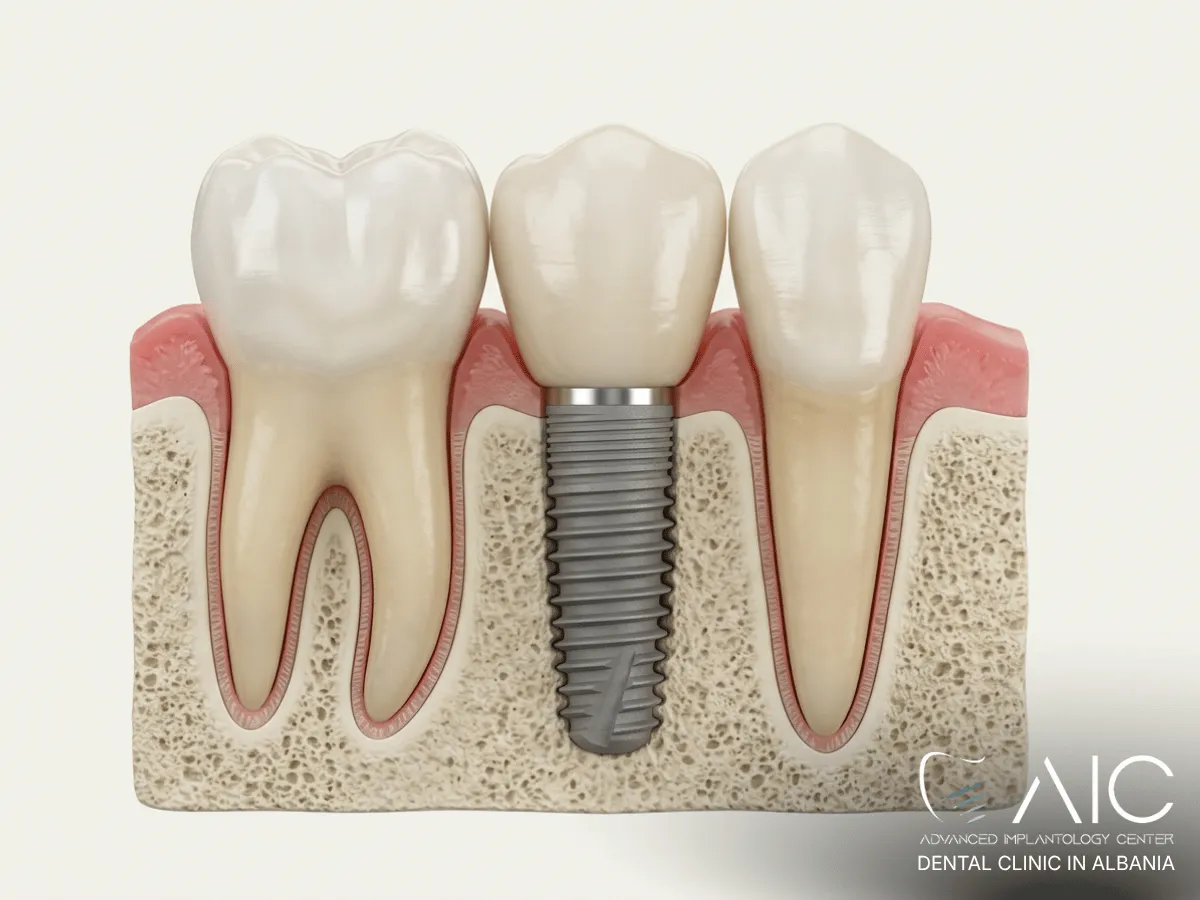
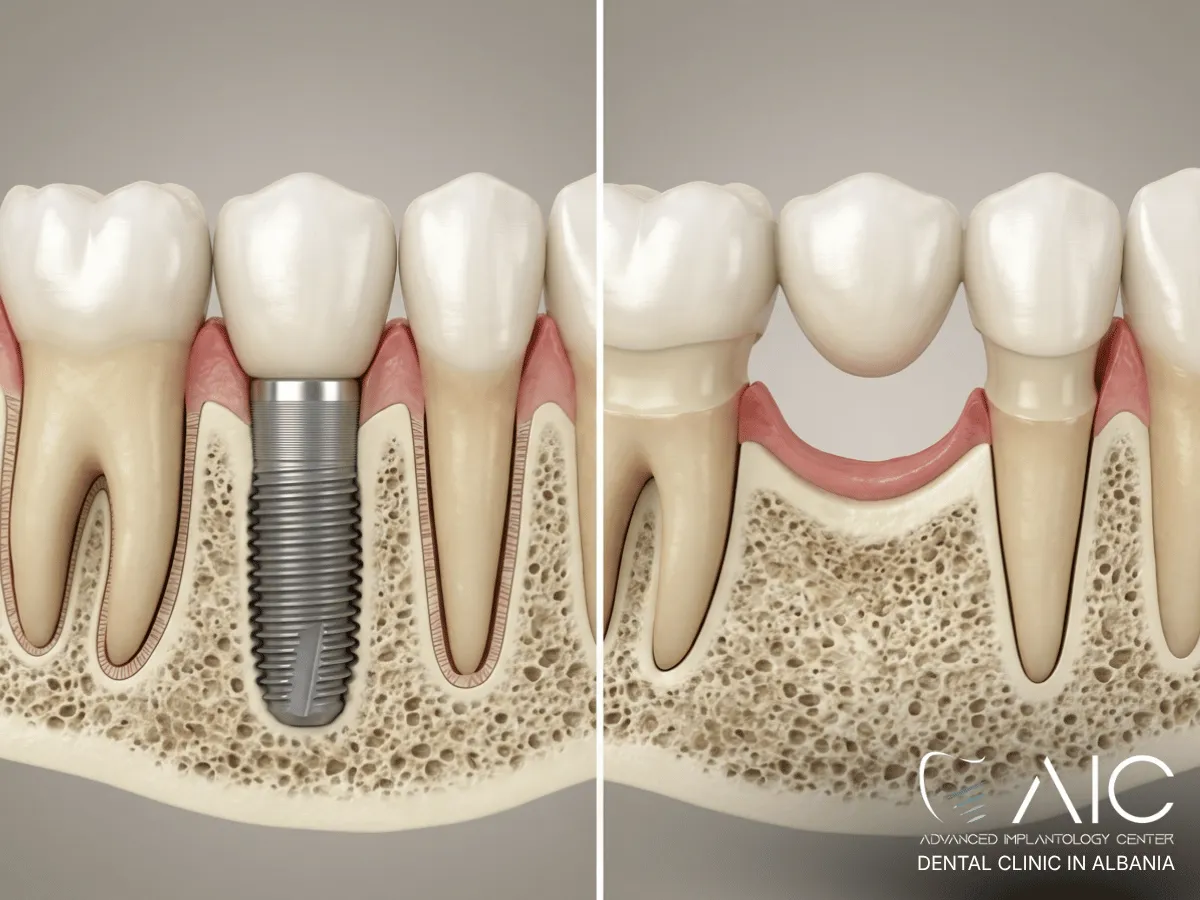
A single dental implant replaces the missing tooth independently. A titanium implant is placed in the jawbone and later supports its own dental crown.
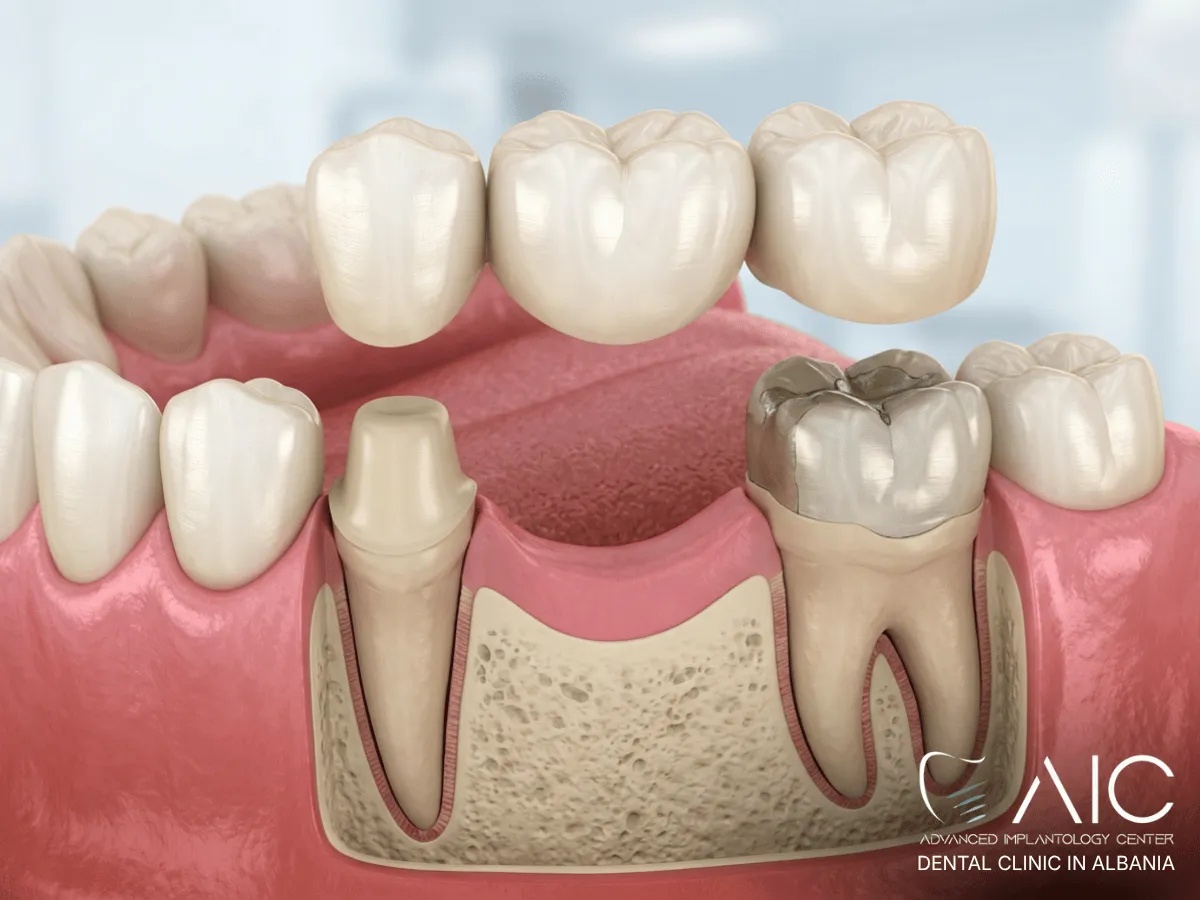
A traditional dental bridge replaces the missing tooth by using the neighboring natural teeth as supports. Those teeth are usually prepared for crowns, with an artificial tooth suspended between them.
For many patients, the most important difference is therefore not simply:
“Which one lasts longer?”
It is:
“Do the neighboring teeth need treatment anyway, or would we be cutting healthy teeth just to support the replacement?”
If both neighboring teeth are intact and healthy, an implant can be an attractive conservative option because those teeth do not need to be prepared.
If the adjacent teeth already have large fillings, fractures or crowns and would benefit from full-coverage restorations anyway, a bridge can become much more reasonable.
Other factors also matter:
- available jawbone;
- gum health;
- medical conditions;
- smoking;
- treatment time;
- whether surgery is acceptable;
- aesthetic requirements;
- cost;
- and long-term maintenance.
This guide compares dental implant vs bridge treatment for one missing tooth so you can understand the advantages, disadvantages and situations in which each option may make more sense.
This article provides general information. The condition of the adjacent teeth, bite, bone and gums should be examined before deciding between an implant and a bridge.
Quick Answer: Is an Implant Better Than a Bridge?
Neither option is automatically better for every patient.
A single implant is often attractive when:
- the neighboring teeth are healthy;
- there is enough bone;
- the gums are healthy or stabilized;
- the patient is suitable for implant surgery;
- and preserving the adjacent teeth is a priority.
A bridge may be particularly appropriate when:
- the neighboring teeth already need crowns;
- implant surgery is contraindicated or undesirable;
- there is significant bone loss that would require additional surgery;
- the patient wants a faster non-surgical restoration;
- or anatomical conditions make implant placement difficult.
Both treatments have established long-term clinical histories.
What Is a Single-Tooth Dental Implant?
A single-tooth implant normally consists of three components:
- Dental implant — the titanium or titanium-alloy fixture placed into the jawbone.
- Abutment — the component connecting the implant to the crown.
- Implant crown — the visible artificial tooth.
The implant acts as an artificial tooth root.
After placement, bone heals around the implant surface through a process called osseointegration.
Once sufficient stability has developed, the implant can support a permanent crown.
Learn more about dental implant treatment.
What Is a Dental Bridge?
A dental bridge is a fixed restoration used to replace one or more missing teeth.
For a traditional three-unit bridge replacing one tooth:
- one neighboring tooth supports one side;
- the other neighboring tooth supports the opposite side;
- and an artificial tooth called a pontic fills the gap.
The two neighboring teeth are called abutment teeth.
They are usually reshaped so that crowns can fit over them.
The crowns and replacement tooth are joined together as one fixed restoration.
The NHS similarly describes a bridge as a fixed replacement supported by surrounding teeth.
Dental Implant vs Bridge: Main Differences
| Dental Implant | Traditional Bridge |
|---|---|
| Replaces the missing tooth independently | Uses neighboring teeth for support |
| Usually requires surgery | Usually does not require implant surgery |
| Healthy adjacent teeth usually remain untouched | Adjacent teeth usually need crown preparation |
| May require several months of healing | Can usually be completed much faster |
| Requires sufficient bone or augmentation | Does not require bone for implant anchorage |
| Requires cleaning around one implant crown | Requires cleaning beneath the bridge pontic |
| Has implant-specific biological and technical complications | Has tooth-, cement-, caries- and prosthesis-related complications |
| Usually higher initial treatment complexity | Often simpler initially when supporting teeth are suitable |
The Biggest Difference: What Happens to the Adjacent Teeth?
This is often the most important factor when replacing one missing tooth.
With an implant
The missing tooth is treated independently.
The teeth beside the gap generally do not need to be drilled or covered with crowns simply to support the implant.
With a traditional bridge
The neighboring teeth normally need to be prepared for full-coverage crowns.
This requires removal of tooth structure.
Once those teeth have been prepared for a conventional bridge, the treatment is generally not reversible.
If the Neighboring Teeth Are Perfectly Healthy
If the teeth on either side of the missing tooth are:
- intact;
- healthy;
- free from large fillings;
- and do not otherwise need crowns,
preparing them solely to support a bridge sacrifices healthy tooth structure.
In this situation, a single implant may offer an important biological advantage because the adjacent teeth can remain largely untouched.
If the Neighboring Teeth Already Need Crowns
This changes the decision considerably.
Imagine that a missing tooth sits between two teeth that already have:
- large failing fillings;
- major fractures;
- significant wear;
- old crowns requiring replacement;
- or substantial structural damage.
If those teeth would benefit from crowns regardless of how the missing tooth is replaced, using them as bridge abutments may make good restorative sense.
In this situation, the argument that a bridge is “damaging healthy teeth” may no longer apply.
Which Lasts Longer: Dental Implant or Bridge?
Both can function successfully for many years.
Long-term systematic-review evidence has reported high survival for both conventional tooth-supported bridges and implant-supported single crowns.
A major systematic review estimated five-year survival at approximately:
- 93.8% for conventional tooth-supported fixed bridges;
- 94.5% for implant-supported single crowns.
At ten years, estimated survival was approximately:
- 89.2% for conventional bridges;
- 89.4% for implant-supported single crowns.
These historical pooled estimates are remarkably similar, but they should not be interpreted as a guarantee for an individual patient because materials, implant systems and clinical protocols have continued to evolve.
How Long Can a Single Dental Implant Last?
A separate systematic review of single implants with at least ten years of follow-up reported implant-level survival of approximately 95%.
The survival of the original implant crown was lower, around 89.5%, because crowns may eventually need repair or replacement even while the implant itself remains integrated.
This distinction matters:
implant survival is not the same as crown survival.
An implant can remain healthy while the ceramic crown, screw or other prosthetic component requires maintenance.
Does a Dental Bridge Last Forever?
No.
Like implants, bridges are long-term restorations rather than permanent guarantees.
A bridge can eventually require repair or replacement because of:
- caries around an abutment tooth;
- loss of cement retention;
- ceramic fracture;
- fracture of an abutment tooth;
- periodontal disease;
- pulpal or endodontic problems;
- or general restorative wear.
Does an Implant Last Forever?
No treatment should be marketed as lifetime guaranteed.
Implant-related complications can include:
- failure of osseointegration;
- peri-implant mucositis;
- peri-implantitis;
- marginal bone loss;
- screw loosening;
- ceramic fracture;
- loss of crown retention;
- and, less commonly, implant fracture.
Long-term research consistently shows high survival for single implants but also confirms that biological and technical complications occur.
Dental Implant vs Bridge: Which Is More Conservative?
When the adjacent teeth are healthy, a single implant is generally more conservative to those teeth.
The implant occupies the missing-tooth site without using the neighboring teeth as prosthetic supports.
However, an implant is not necessarily less invasive overall.
It requires surgery.
Depending on anatomy, treatment may also require:
- tooth extraction;
- bone grafting;
- soft-tissue grafting;
- or sinus augmentation.
A bridge involves more preparation of natural teeth but usually avoids implant surgery.
“Conservative” therefore depends on what tissue you are trying to preserve.
Which Is Faster: Implant or Bridge?
A bridge is usually faster.
A conventional bridge can often be completed after:
- tooth preparation;
- impression or digital scan;
- temporary restoration;
- laboratory fabrication;
- and final cementation.
An implant treatment may require:
- extraction if the tooth is still present;
- implant placement;
- osseointegration;
- soft-tissue maturation;
- digital or conventional impressions;
- and crown fabrication.
The complete process may therefore take several months.
Can a Dental Implant Be Done Immediately?
Sometimes.
An implant can occasionally be placed immediately when the failing tooth is extracted.
This is called immediate implant placement.
It depends on factors such as:
- socket anatomy;
- available bone;
- infection control;
- gum condition;
- implant stability;
- and the planned final crown position.
Immediate placement does not mean every case can receive the permanent crown immediately.
Learn more about same-day dental implants.
Can You Get a Temporary Tooth While an Implant Heals?
Often, yes.
Depending on the location and bite, temporary options may include:
- a temporary removable tooth;
- a bonded temporary restoration;
- or an immediate temporary implant crown in carefully selected cases.
Temporary restoration is especially important when replacing a visible front tooth.
Dental Implant vs Bridge for a Front Tooth
The aesthetic zone creates additional considerations.
An implant replacing a front tooth needs:
- correct three-dimensional implant placement;
- adequate facial bone;
- appropriate gum thickness;
- stable tissue architecture;
- and a carefully designed crown.
Even a well-integrated implant can have a poor cosmetic result if it is positioned incorrectly.
Why Gum Architecture Matters Around a Front Implant
Natural teeth are supported by:
- tooth roots;
- periodontal ligaments;
- bone;
- and gingival fibers.
An implant has a different biological attachment.
If bone or gum tissue is deficient, the implant crown can develop:
- recession;
- an elongated appearance;
- asymmetric gum levels;
- or visible metal or abutment components.
Front-tooth implant planning is therefore both surgical and aesthetic.
Can a Bridge Look More Natural Than an Implant?
Sometimes.
A well-designed bridge can achieve excellent aesthetics, particularly when:
- the neighboring teeth already need crowns;
- gum architecture is difficult for implant placement;
- significant ridge deficiency is present;
- or implant positioning would compromise the final appearance.
Conversely, an ideally positioned implant with healthy tissue can closely reproduce a natural single tooth.
Neither option automatically guarantees superior aesthetics.
Dental Implant vs Bridge for a Missing Molar
A missing molar creates a different biomechanical problem.
Back teeth receive substantial chewing forces.
A single implant can independently support a molar crown when adequate bone and implant dimensions are available.
A conventional bridge can also replace a molar if suitable teeth exist on both sides of the gap.
The decision should consider:
- strength of the supporting teeth;
- size of existing restorations;
- bite forces;
- bruxism;
- bone anatomy;
- and whether a tooth actually exists behind the missing molar.
What if There Is No Tooth Behind the Missing Tooth?
A conventional bridge usually relies on support on both sides of the gap.
If the last molar is missing and there is no tooth behind it, a traditional three-unit bridge may not be possible.
A cantilever bridge may sometimes be considered, but biomechanics must be carefully assessed.
An implant often becomes particularly useful for a terminal missing tooth because it can provide support without needing a tooth behind the space.
Does an Implant Preserve Jawbone Better Than a Bridge?
After a natural tooth is removed, the surrounding alveolar ridge remodels.
A conventional bridge replaces the visible tooth but does not place a root-like structure in the missing-tooth site.
An implant is placed within the edentulous ridge and transfers functional forces to surrounding bone.
However, it is too simplistic to say that an implant completely “prevents bone loss.”
Bone around implants also remodels, and marginal bone changes can occur throughout function.
A more accurate statement is:
an implant provides direct functional anchorage within the missing-tooth site, whereas a traditional bridge leaves the edentulous ridge without an implant fixture.
What if There Is Not Enough Bone for an Implant?
Insufficient bone does not always rule out implant treatment.
Depending on the defect, options may include:
- guided bone regeneration;
- socket grafting;
- ridge augmentation;
- shorter implants in selected cases;
- or sinus augmentation in the upper posterior jaw.
However, additional surgery changes the comparison.
A patient deciding between:
- a simple bridge;
- and an implant requiring significant bone grafting
is making a different decision from someone who already has ideal bone for straightforward implant placement.
Learn more about bone grafting for dental implants.
Does a Dental Bridge Require Bone Grafting?
No bone graft is needed simply to support a traditional tooth-supported bridge.
The bridge relies on the neighboring teeth rather than an implant in the missing-tooth site.
However, severe ridge collapse can still affect the appearance of the pontic, particularly in the front of the mouth.
Soft-tissue or ridge augmentation may occasionally be considered for aesthetic reasons even when no implant is being placed.
Which Hurts More: Implant or Bridge?
An implant requires surgery, so patients can expect a postoperative healing period.
Common short-term symptoms may include:
- tenderness;
- swelling;
- minor bleeding;
- and temporary discomfort.
A bridge normally avoids bone surgery but requires preparation of the supporting teeth.
Those teeth can experience temporary sensitivity after preparation.
Pain varies significantly between patients and should not be the only factor used to choose treatment.
Does Getting a Bridge Damage the Adjacent Teeth?
Preparing a conventional bridge intentionally removes tooth structure from the supporting teeth.
This does not mean those teeth will necessarily become unhealthy.
Well-designed crowns and bridges can function successfully for many years.
However, abutment teeth remain susceptible to biological complications such as:
- caries around restoration margins;
- periodontal disease;
- pulpal complications;
- fracture;
- and loss of retention.
These potential complications are particularly relevant when the supporting teeth were completely healthy before treatment.
Can Bridge Preparation Lead to Root Canal Treatment?
It can in some cases, but it is not inevitable.
Preparing a tooth for a crown removes enamel and dentin.
If a tooth has:
- a large existing filling;
- previous trauma;
- limited remaining dentin;
- or pre-existing pulpal disease,
its risk of later requiring endodontic treatment can be greater.
A bridge should therefore be planned after evaluating the condition and prognosis of both potential abutment teeth.
What Happens if One Bridge Tooth Fails?
This is one disadvantage of connecting several teeth into one restoration.
If one supporting tooth develops:
- severe decay;
- root fracture;
- periodontal failure;
- or another non-restorable problem,
the entire bridge may need to be removed or redesigned.
The prognosis of a bridge therefore depends partly on the prognosis of every supporting tooth.
What Happens if an Implant Crown Fails?
A problem with the implant crown does not necessarily mean that the implant fixture has failed.
For example:
- a crown can chip;
- a screw can loosen;
- cement retention can fail;
- or the crown can need replacement
while the implant itself remains completely osseointegrated.
This modular design can be useful during long-term maintenance.
Which Is Easier to Clean?
A single implant crown is generally cleaned similarly to a natural tooth, with attention to the peri-implant gumline and interdental spaces.
A bridge requires an additional step because ordinary floss cannot pass vertically between the connected replacement tooth and its crowns.
The patient may need:
- super floss;
- a floss threader;
- interdental brushes;
- or an oral irrigator
to clean underneath the pontic.
Can a Bridge Get Cavities?
The artificial bridge material itself cannot develop caries.
However, the natural teeth underneath the bridge crowns still can.
Decay may develop around crown margins if plaque accumulates or margins become compromised.
Can an Implant Get Cavities?
No.
Titanium and ceramic cannot develop dental caries.
But implants can develop inflammatory disease.
Plaque accumulation can contribute to:
- peri-implant mucositis;
- and peri-implantitis.
Peri-implantitis includes inflammation together with progressive supporting bone loss.
Therefore, implants still require meticulous daily hygiene and professional maintenance.
Which Is Better if You Have Gum Disease?
Active periodontal disease should be treated before either definitive option is chosen.
A bridge supported by periodontally compromised teeth can have a poor prognosis if those teeth continue losing attachment.
Likewise, patients with a history of periodontitis have a higher long-term risk of peri-implant disease.
The goal is therefore to stabilize periodontal health before replacing the missing tooth.
Learn more about dental implants after gum disease and our periodontal treatments.
Dental Implant vs Bridge if You Smoke
Smoking deserves particular consideration when implant treatment is planned.
Smoking is associated with higher risks of:
- early implant failure;
- impaired healing;
- peri-implant disease;
- and marginal bone loss.
A bridge avoids implant osseointegration, but smoking still negatively affects gum and periodontal health around the supporting teeth.
Smoking therefore does not make a bridge risk-free.
Dental Implant vs Bridge With Diabetes
Diabetes does not automatically rule out implant treatment.
However, poor glycemic control can increase healing and peri-implant risks.
If diabetes is well managed and the patient is otherwise suitable, an implant may still be considered.
A bridge avoids implant surgery but still depends on healthy supporting teeth and periodontal tissues.
Dental Implant vs Bridge if You Take Blood Thinners
Taking anticoagulant medication does not automatically prevent implant surgery.
But implant placement is a surgical procedure and requires an individualized bleeding-risk assessment.
A conventional bridge normally involves less surgical bleeding because no implant osteotomy is required.
However, medication should never be stopped merely to make implant treatment easier without professional guidance.
Is Age a Reason to Choose a Bridge Instead of an Implant?
Not by itself.
There is no universal upper age limit for dental implants.
A medically stable patient in their 70s or 80s may still be a good implant candidate.
The more important factors are:
- health;
- frailty;
- medications;
- bone;
- hygiene ability;
- and treatment goals.
Read more about dental implants after 70.
What if You Grind Your Teeth?
Bruxism can affect both implants and bridges.
Excessive forces can contribute to:
- ceramic chipping;
- crown fracture;
- bridge complications;
- implant screw loosening;
- and mechanical wear.
The dentist may adjust the prosthetic design, bite or recommend a protective nightguard.
Which Feels More Like a Natural Tooth?
Both can feel very natural once the patient adapts.
An implant-supported crown has the advantage of being an individual replacement rather than being physically connected to the neighboring teeth.
However, an implant does not have a periodontal ligament and therefore does not reproduce every sensory characteristic of a natural tooth.
A bridge is supported by natural teeth, which retain periodontal ligament sensation, but the connected units behave as one prosthetic restoration.
Which Option Is Better for the Bite?
Either can restore effective chewing when correctly designed.
The treatment should consider:
- location of the missing tooth;
- opposing teeth;
- bite force;
- bruxism;
- space available;
- implant dimensions;
- and the condition of potential bridge abutments.
Dental Implant vs Bridge Cost
The initial cost structure is different.
A single implant normally involves:
- surgical planning;
- implant placement;
- implant components;
- and the final crown.
If grafting is necessary, the cost increases further.
A traditional bridge normally involves:
- preparation of two supporting teeth;
- three connected prosthetic units;
- temporary restorations;
- and the final bridge.
A bridge may sometimes have a lower or more predictable initial cost, especially when no additional treatment is required.
However, the correct comparison should include the condition and future treatment needs of the neighboring teeth.
Is an Implant Cheaper in the Long Term?
Not necessarily for every patient.
It is common to see claims that implants are always cheaper over a lifetime, but long-term costs depend on:
- implant complications;
- crown replacement;
- bridge replacement;
- caries risk;
- periodontal disease;
- bone grafting;
- and how long each restoration survives.
A well-maintained bridge can function for many years.
A well-maintained implant can also function for decades.
Treatment should therefore be selected clinically rather than through a simplistic lifetime-cost promise.
Does a Missing Tooth Have to Be Replaced?
Not every missing tooth automatically requires replacement.
Factors include:
- which tooth is missing;
- appearance;
- chewing function;
- movement of neighboring teeth;
- opposing tooth position;
- bite stability;
- and patient preference.
In some carefully selected situations, leaving a space may be reasonable.
In others, replacement helps restore function, appearance or occlusal stability.
What About a Maryland or Resin-Bonded Bridge?
A conventional three-unit bridge is not the only bridge option.
A resin-bonded bridge, often called a Maryland bridge, uses a wing bonded to one or more neighboring teeth rather than full crowns.
This can require little or no tooth preparation.
It is particularly useful in selected single-tooth situations, often in the anterior region.
Modern adhesive techniques have expanded the possibilities for conservative resin-bonded bridges, although case selection and bonding conditions are critical.
Implant vs Maryland Bridge
A resin-bonded bridge may be attractive when:
- the patient is young;
- implant placement should be delayed;
- adjacent teeth are healthy;
- bone or medical factors make surgery undesirable;
- or a minimally invasive fixed replacement is preferred.
Potential disadvantages include debonding and restrictions created by the bite and available enamel.
Recent clinical literature continues to investigate minimally invasive cantilever resin-bonded restorations as an alternative for individual missing teeth.
Can Teenagers Get a Dental Implant?
Implant placement is generally delayed until craniofacial growth is sufficiently complete.
An implant behaves like an ankylosed structure and does not erupt with the neighboring natural teeth as growth continues.
A resin-bonded bridge or removable temporary tooth may therefore be more suitable for a younger patient until definitive implant timing is appropriate.
Can You Replace a Bridge With an Implant Later?
Often, yes.
If an existing bridge fails, the teeth and missing-tooth site can be reassessed.
Possible options include:
- another bridge;
- a single implant;
- or a different restorative plan.
The condition of the former bridge abutment teeth will influence the decision.
Can You Replace an Implant With a Bridge if It Fails?
Potentially.
If an implant fails and is removed, a traditional bridge may be considered if suitable teeth exist on both sides of the space.
Alternatively, the site may be reconstructed and another implant placed.
What Tests Are Needed Before Choosing an Implant?
Implant assessment may include:
- clinical examination;
- periodontal assessment;
- radiographs;
- CBCT when indicated;
- evaluation of bone width and height;
- assessment of neighboring roots;
- bite analysis;
- and review of medical history.
Do You Need a CBCT for a Bridge?
Not usually solely for preparation of a straightforward tooth-supported bridge.
Standard dental radiographs are commonly sufficient to evaluate:
- supporting teeth;
- roots;
- bone levels;
- existing fillings;
- and signs of dental disease.
CBCT may be required for other clinical reasons but is much more commonly relevant when planning an implant.
When Is an Implant Often the Better Choice?
A single implant may be especially attractive when:
- one tooth is missing;
- the teeth on either side are healthy;
- sufficient bone is available;
- the patient is medically suitable;
- gum health is stable;
- surgery is acceptable;
- and preserving the neighboring teeth is a priority.
When Is a Bridge Often the Better Choice?
A bridge may make more sense when:
- neighboring teeth already need crowns;
- implant surgery is not desired;
- medical factors make elective implant surgery unsuitable;
- bone grafting would make implant treatment disproportionately complex;
- the patient wants a faster fixed restoration;
- or anatomy prevents predictable implant placement.
When Should You Avoid Making the Decision Based Only on Price?
Replacing one tooth affects more than the empty space.
A low initial price may not represent the best treatment if it requires unnecessary preparation of healthy teeth.
Conversely, choosing an implant solely because it is considered more advanced may not make sense when the neighboring teeth already require crowns.
The decision should include:
- prognosis of neighboring teeth;
- bone;
- treatment complexity;
- maintenance;
- patient preference;
- and total restorative needs.
Dental Implant vs Bridge: Decision Example 1
One missing premolar between two completely healthy teeth.
There is sufficient bone and the patient is medically suitable for implant surgery.
In this situation, an implant may be particularly attractive because it replaces the missing tooth independently without preparing the healthy neighboring teeth.
Dental Implant vs Bridge: Decision Example 2
One missing tooth between two heavily restored teeth that both require crowns.
A conventional bridge may be an efficient treatment because crown preparation of the neighboring teeth is already indicated.
Dental Implant vs Bridge: Decision Example 3
One missing upper tooth with major bone loss requiring grafting.
The patient may need to compare:
- implant surgery plus augmentation and a longer treatment period;
- with a bridge that avoids graft surgery.
Neither answer is automatically correct.
Dental Implant vs Bridge: Decision Example 4
One missing last molar with no natural tooth behind the space.
A traditional bridge may not have a suitable posterior abutment.
A single implant can provide independent support and may therefore be particularly useful.
Questions to Ask Before Choosing an Implant
- Do I have enough bone?
- Would I need bone grafting?
- Can the implant be placed in the ideal restorative position?
- How long will treatment take?
- Can I have a temporary tooth?
- What are my personal risk factors?
- How will the implant crown be maintained?
- What happens if the crown or screw needs repair later?
Questions to Ask Before Choosing a Bridge
- Are the supporting teeth healthy?
- Would they need crowns even if I chose an implant?
- How much natural tooth structure must be removed?
- What is the periodontal prognosis of the abutment teeth?
- Can the bridge be cleaned easily?
- What happens if one supporting tooth fails?
- Would a resin-bonded bridge be possible instead?
Frequently Asked Questions About Dental Implant vs Bridge
Which is better, a bridge or an implant?
Neither is universally better. An implant often has an advantage when the adjacent teeth are completely healthy because those teeth do not need to be prepared. A bridge may be preferable when neighboring teeth already require crowns or implant surgery is unsuitable.
What is the best way to replace one missing tooth?
Common fixed options include a single implant crown, traditional bridge and, in selected cases, a resin-bonded bridge. The best choice depends on adjacent teeth, bone, gum health, bite, medical history and patient preference.
Is an implant stronger than a bridge?
Both can withstand normal chewing when correctly designed. Strength alone is not a useful way to choose between them because they use different support systems.
Does an implant last longer than a bridge?
Not necessarily in every patient. Long-term studies show high survival for both conventional bridges and single implant restorations. Individual risk factors and maintenance strongly influence longevity.
What lasts 20 years, an implant or bridge?
Either may function for a very long time in selected patients, but neither should be promised for a specific lifespan. Components, crowns or entire restorations may require maintenance or replacement.
Why do dentists prefer implants?
One major reason is that a single implant can replace a missing tooth without preparing healthy neighboring teeth. However, this advantage is less important when those neighboring teeth already need crowns.
Why would a dentist recommend a bridge instead of an implant?
Possible reasons include insufficient bone, medical contraindications, patient preference, faster treatment needs, unfavorable implant anatomy or neighboring teeth that already require crowns.
Is a bridge cheaper than an implant?
A bridge may have a lower or simpler initial treatment cost in some situations, particularly when no surgery or grafting is required. Actual costs depend on treatment complexity and materials.
Is a bridge faster than an implant?
Usually yes. An implant often requires a healing period for osseointegration, while a conventional bridge can generally be completed much sooner.
Does a bridge destroy healthy teeth?
A conventional bridge requires intentional preparation of its supporting teeth. This removes natural tooth structure, but properly selected and well-made bridge abutments can function successfully for many years.
Do bridges cause root canals?
Not routinely. However, some prepared abutment teeth can later develop pulpal problems requiring root canal treatment, particularly if they were already heavily restored or compromised.
Can an implant get a cavity?
No. The titanium implant and ceramic crown cannot decay, but plaque-associated peri-implant diseases can affect the surrounding tissues.
Can a tooth under a bridge get a cavity?
Yes. Natural abutment teeth remain susceptible to decay around crown margins.
Can I get an implant if I have bone loss?
Potentially. Some bone defects can be reconstructed with bone grafting, but additional surgery changes treatment time, complexity and cost.
Which looks better, an implant or bridge?
Both can provide excellent aesthetics. The result depends on implant or tooth position, gum architecture, bone, materials, laboratory work and restorative planning.
Is an implant better for a front tooth?
An implant can be an excellent front-tooth replacement when anatomy and tissue conditions are favorable. A bridge may sometimes provide a more predictable aesthetic solution when major ridge or gum defects exist.
Is an implant better for a missing molar?
It can be particularly useful because it independently supports the missing molar and does not require support from neighboring teeth. Bone anatomy and bite forces must still be evaluated.
Can I have a bridge now and an implant later?
Often yes, although the neighboring teeth will already have been prepared if a conventional bridge was used. Future implant feasibility depends on bone and the condition of the area.
Can I get a bridge without shaving my teeth?
A resin-bonded or Maryland bridge can sometimes replace a tooth with minimal preparation. It is not suitable for every gap or bite.
Is a dental implant worth the longer treatment time?
For a patient with healthy adjacent teeth and suitable anatomy, preserving those teeth can make the longer implant process worthwhile. For another patient, the simplicity and speed of a bridge may be more valuable.
Dental Implant vs Bridge: The Bottom Line
Both dental implants and bridges are established ways to replace one missing tooth.
The main difference is how they obtain support.
A traditional bridge uses neighboring natural teeth.
A dental implant creates independent support within the missing-tooth site.
If the teeth beside the gap are completely healthy, a single implant often provides an important conservative advantage because those teeth do not have to be prepared for crowns.
If the neighboring teeth are already heavily restored and need crowns, that advantage becomes much smaller and a bridge may be an excellent solution.
The decision should also account for:
- bone volume;
- gum condition;
- medical health;
- smoking;
- treatment time;
- aesthetic demands;
- cleaning ability;
- cost;
- and long-term maintenance.
Long-term evidence shows that both conventional tooth-supported bridges and single implant crowns can achieve high survival when appropriately planned.
So the question should not simply be:
“Is an implant better than a bridge?”
It should be:
“Which solution preserves the healthiest structures and gives the most predictable result in my specific mouth?”
At SOTA Dental – Advanced Implantology Center, single-tooth replacement can be planned using clinical examination, digital imaging and restorative assessment to determine whether a single implant, conventional bridge or another treatment is most appropriate.
Learn more about our dental implants, dental crowns and cosmetic dentistry, bone grafting and periodontal care.
Scientific References
Pjetursson BE et al. Comparison of survival and complication rates of tooth-supported fixed dental prostheses and implant-supported fixed prostheses and single crowns. PMID: 17594374.
Jung RE et al. Systematic review of survival and biological, technical and aesthetic complications of implant-supported single crowns. PMID: 23062124.
Chrcanovic BR et al. A systematic review of survival of single implants with at least 10 years of follow-up. PMID: 27314122.
Sailer I et al. Single and partial tooth replacement with fixed dental prostheses supported by dental implants: systematic review of clinical outcomes. PMID: 35246885.
Hawthan M et al., 2024. Survival of fixed prosthetic restorations on vital and nonvital teeth: A systematic review. PMID: 37455556.
American and international prosthodontic literature. Treatment selection should consider the prognosis of the abutment teeth, anatomy, periodontal health, patient preferences and long-term maintenance rather than relying on restoration survival alone.
Medical disclaimer: This article provides general educational information. The condition of the missing-tooth site, adjacent teeth, gums, bone, bite and medical history should be assessed by a dentist before choosing a dental implant or bridge.