
In many staged dental bone-grafting cases, implants are placed approximately three to six months after the graft. However, larger or more complex grafts may require six to nine months or longer before implant placement.
There is no single waiting period that applies to every bone graft.
In fact, some patients do not need to wait at all.
If enough healthy native bone remains to stabilize the implant, the surgeon may be able to place the implant and bone graft during the same procedure.
The correct timeline depends on:
- the type of bone graft;
- the size of the bone defect;
- whether the graft is horizontal or vertical;
- how much native bone remains;
- the graft material;
- where in the jaw the treatment is performed;
- soft-tissue healing;
- smoking;
- medical conditions;
- and whether adequate implant stability can be achieved.
This means the most accurate answer to “how long after a bone graft can you get an implant?” is:
when enough stable, healthy bone has developed to place the implant safely in the correct position — not simply when a certain number of months has passed.
This guide explains typical bone-graft healing times, why some implants can be placed immediately, why others require months of healing, and how your implant surgeon determines when the graft is ready.
This article provides general educational information. Your surgeon’s recommendations take priority because implant timing must be based on your individual anatomy and healing.
Quick Answer: How Long After a Bone Graft Can You Get an Implant?
Common treatment pathways include:
| Bone Graft Situation | Typical Implant Timing |
|---|---|
| Small graft around an implant | Implant and graft may be performed at the same appointment |
| Socket preservation after extraction | Often around 3–6 months |
| Localized staged guided bone regeneration | Often around 4–6 months |
| Large horizontal ridge augmentation | Often around 6 months; some protocols use 6–9 months |
| Block bone graft | Often approximately 4–6 months or longer depending on the defect |
| Vertical ridge augmentation | Frequently several months; published protocols often reassess around 4–9 months |
| Staged sinus augmentation | Often several months before implant placement, depending on residual bone and graft maturation |
These ranges are planning examples, not guaranteed deadlines.
One patient may be ready earlier while another patient with a larger defect requires additional healing.
Why Do You Need a Bone Graft Before a Dental Implant?
Dental implants need enough bone to provide:
- initial mechanical stability;
- correct three-dimensional implant positioning;
- bone surrounding the implant;
- and a stable foundation for long-term function.
Bone can be lost after:
- tooth extraction;
- many years without teeth;
- periodontitis;
- infection;
- trauma;
- failed dental implants;
- or prolonged denture use.
If the remaining jawbone is too thin, too short or irregularly shaped, simply placing an implant into the available bone may result in a poor implant position or inadequate stability.
Bone grafting is used to rebuild or preserve the ridge so the future implant can be placed more predictably.
Learn more about bone grafting for dental implants.
Can the Bone Graft and Implant Be Done at the Same Time?
Yes, in selected cases.
This is known as simultaneous implant placement and bone augmentation.
It may be possible when enough native bone remains to hold the implant firmly during surgery.
The graft is then used to regenerate bone around areas where the implant would otherwise be partially deficient.
For example, an implant may achieve strong primary stability in the existing ridge while a localized facial bone defect is reconstructed using guided bone regeneration.
In these cases there is no waiting period between grafting and implant placement because both procedures occur during the same surgery.
What Is Primary Implant Stability?
Primary stability is the mechanical stability of the implant at the moment it is inserted.
It comes mainly from engagement between the implant and existing native bone.
This is important because the implant must remain sufficiently stable during early healing for predictable osseointegration.
If there is not enough native bone to stabilize the implant, placing it simultaneously with the graft may not be appropriate.
The surgeon may instead choose a staged procedure.
What Is Staged Bone Grafting?
Staged treatment separates bone reconstruction and implant placement into different surgeries.
The sequence is typically:
- bone graft surgery;
- several months of biological healing;
- clinical and radiographic reassessment;
- implant placement;
- implant osseointegration;
- final crown or bridge.
Staged grafting is commonly used when the existing ridge is too deficient to hold the implant securely or when the ideal implant position cannot be achieved without first rebuilding the bone.
Why Does a Dental Bone Graft Need Months to Heal?
A bone graft does not instantly become mature living jawbone.
After grafting, a sequence of biological events occurs.
Blood clot and early healing
Immediately after surgery, a blood clot develops around the grafted area.
Inflammatory and repair processes begin.
Blood-vessel formation
The grafted region needs vascularization.
New blood vessels progressively enter the regenerative area and provide oxygen, nutrients and cells involved in bone formation.
New bone formation
Bone-forming cells begin depositing new mineralized tissue.
Depending on the graft material, the graft can act as a scaffold around which the patient’s own bone develops.
Remodeling and maturation
Newly formed bone continues reorganizing and maturing.
This process lasts substantially longer than gum healing.
That is why a patient can feel completely normal while the graft is still biologically developing.
Soft-Tissue Healing Is Not the Same as Bone Healing
This distinction is extremely important.
The gum may:
- close within the first weeks;
- stop hurting;
- lose its swelling;
- and appear completely healed.
But deeper bone regeneration can continue for months.
The absence of pain does not mean the graft is ready for an implant.
How Long Does a Dental Bone Graft Take to Heal?
For many routine procedures, several months are allowed for graft maturation.
A useful general range is approximately:
3–6 months for many localized grafts.
However, more extensive reconstruction may require:
6–9 months or longer.
The ITI describes guided bone regeneration as a technique that can often be performed simultaneously with implant placement for smaller local defects, while extended defects may require staged augmentation followed by implant placement approximately four to six months later.
Clinical trials of severe horizontal ridge defects have also used healing periods of six to nine months before implant insertion.
Bone Graft Healing Is Not Complete at One Exact Date
Bone biology does not suddenly change from “unhealed” to “healed” on one specific day.
Healing is continuous.
The surgeon is trying to determine whether enough mature and mechanically useful bone exists for:
- implant preparation;
- correct implant positioning;
- primary stability;
- and predictable long-term support.
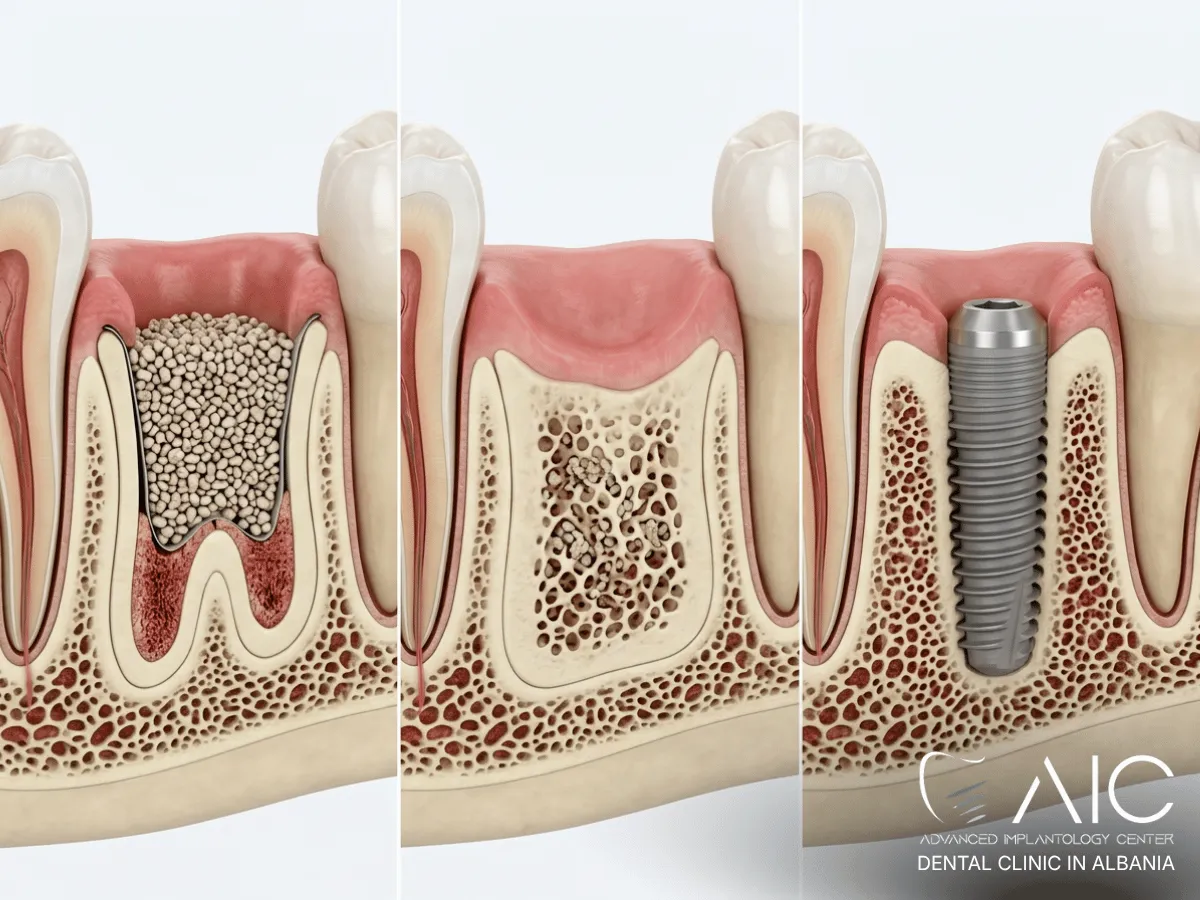
How Long After Socket Preservation Can You Get an Implant?
Implant placement after socket preservation is often considered after approximately three to six months.
Socket preservation, also called alveolar ridge preservation, is performed immediately after tooth extraction.
Graft material is placed into the extraction socket to help limit the natural collapse of the ridge while the area heals.
Recent systematic reviews continue to show that ridge-preservation procedures can reduce post-extraction changes in:
- ridge width;
- ridge height;
- and soft-tissue architecture.
This can make later implant placement easier.
However, socket preservation does not completely prevent bone remodeling.
Why Might an Implant Be Placed Around Three Months After a Socket Graft?
In favorable sites, enough healing may have occurred after several months to allow implant placement.
The clinician still needs to assess:
- socket anatomy;
- facial bone condition;
- graft maturation;
- soft tissue;
- and the desired implant position.
Three months should therefore be understood as a possible clinical timing point rather than a universal deadline.
Why Might the Dentist Wait Six Months?
A longer interval may be selected when:
- the original defect was larger;
- the socket had significant bone-wall destruction;
- bone formation appears slower;
- the graft material remodels gradually;
- the site is in a difficult anatomical area;
- or additional maturity is desired before implant preparation.
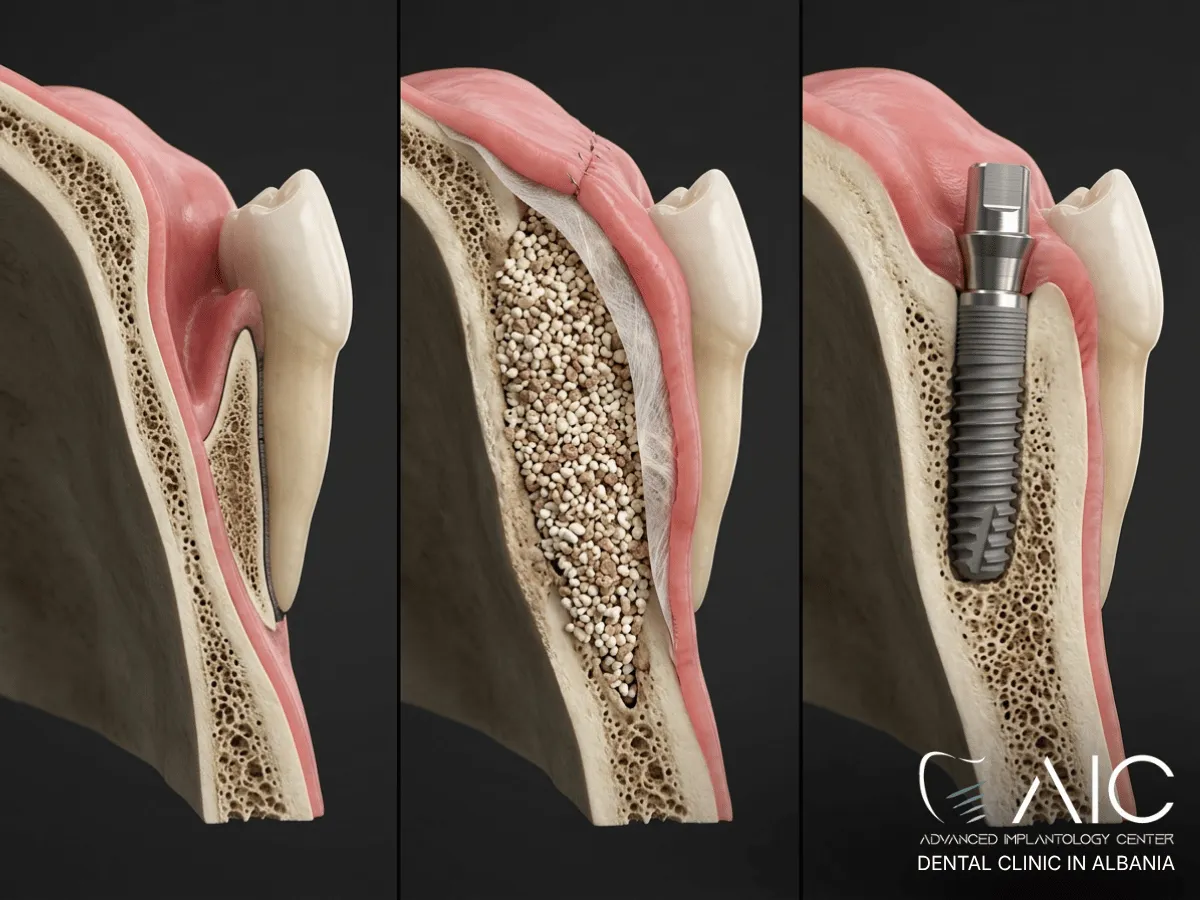
What Is Guided Bone Regeneration?
Guided bone regeneration, or GBR, is one of the most widely used techniques for rebuilding implant sites.
The procedure commonly combines:
- bone graft material;
- a barrier membrane;
- and stable wound closure.
The membrane helps maintain regenerative space and limits rapid soft-tissue invasion of the area intended for bone regeneration.
How Long After GBR Can an Implant Be Placed?
The answer depends on whether GBR is simultaneous or staged.
Simultaneous GBR
The implant and graft are placed during the same procedure.
This is commonly considered when the implant can achieve sufficient stability from native bone despite a localized defect.
Staged GBR
The bone is reconstructed first.
The ITI describes implant placement approximately four to six months later for extended defects treated with a staged approach.
Larger or more challenging reconstructions may be allowed to heal for longer.
How Long After Horizontal Ridge Augmentation Can You Get an Implant?
Horizontal ridge augmentation is used when the jaw is too narrow for ideal implant placement.
In some cases, the implant can be placed simultaneously.
With severe horizontal deficiency, augmentation may be performed first.
A randomized clinical trial involving severe horizontal atrophy placed implants after approximately six to nine months of healing.
Another randomized study comparing bone and dentin block augmentation placed implants at six months.
These studies illustrate why substantial ridge reconstruction often requires a longer healing interval than a small simultaneous graft.
How Long After a Block Bone Graft Can You Get an Implant?
Block grafts are generally used for defects requiring more substantial reconstruction.
Bone may be obtained from:
- another area of the patient’s jaw;
- or another appropriate graft source depending on the technique.
The block is stabilized against the deficient ridge and allowed to integrate.
Many published protocols reassess block grafts at approximately four to six months, while some cases require longer.
One randomized clinical trial evaluating horizontal ridge augmentation placed implants six months after block grafting.
How Long After Vertical Bone Grafting Can You Get an Implant?
Vertical bone augmentation is generally more complex than rebuilding width alone.
It may use:
- guided bone regeneration;
- titanium-reinforced membranes;
- mesh;
- block or shell techniques;
- or other advanced reconstructive methods.
Recent systematic-review data show that staged vertical augmentation studies commonly perform re-entry and implant placement after approximately four to nine months, depending on the technique.
Vertical reconstruction also has a greater risk of wound-related complications than simple localized grafting.
What if I Had a Sinus Bone Graft?
A sinus lift follows a different healing pathway because the graft is placed beneath the elevated maxillary sinus membrane.
Implants may be:
- placed during the sinus lift;
- or placed months later after the graft matures.
If enough native bone remains to provide primary implant stability, simultaneous implant placement may be possible.
If only a very small amount of native bone remains, a staged sinus lift may be safer.
Read our complete guide to sinus lift recovery and implant timing.
Why Can Some Bone Grafts Heal Faster Than Others?
Healing depends on much more than graft size.
Important factors include:
- blood supply;
- defect morphology;
- amount of native bone contacting the graft;
- stability of the graft;
- graft material;
- membrane stability;
- soft-tissue closure;
- patient biology;
- and absence of infection.
Does Graft Material Change the Waiting Time?
Potentially.
Dental grafts may contain:
- autogenous bone from the patient;
- allograft;
- xenograft;
- synthetic bone substitutes;
- or combinations.
These materials do not all remodel at exactly the same rate.
Autogenous Bone
Autogenous bone is harvested from the patient’s own body.
It has biological properties that make it particularly useful in advanced reconstruction.
However, harvesting it can require an additional surgical site.
Allograft
Allograft material comes from processed human donor bone.
It is used in many forms of implant-site regeneration.
Xenograft
Xenografts are commonly derived from processed animal bone.
They can act as long-lasting scaffolds and may remodel relatively slowly.
Residual graft particles can sometimes remain visible histologically long after the site has become clinically suitable for implant placement.
Synthetic Bone Grafts
Synthetic graft materials include various calcium-phosphate and other biocompatible materials.
Their resorption and replacement characteristics vary according to composition.
Does Every Graft Have to Completely Turn Into New Bone Before an Implant?
No.
This is a common misconception.
Some graft materials are designed to remodel gradually, and residual particles can remain integrated within newly formed bone.
The clinical question is not whether every graft particle has disappeared.
The important question is whether the regenerated site provides enough:
- healthy supporting tissue;
- bone volume;
- bone quality;
- and mechanical stability
for predictable implant placement.
How Does the Dentist Know the Bone Graft Is Ready?
The decision can involve several factors.
1. Healing time
The surgeon considers how long the graft has been healing and what type of augmentation was performed.
2. Clinical examination
The soft tissues should be healthy without:
- swelling;
- drainage;
- wound opening;
- or infection.
3. Radiographic assessment
Dental radiographs or CBCT may be used when appropriate to evaluate:
- ridge width;
- ridge height;
- graft volume;
- anatomical structures;
- and the planned implant position.
4. Surgical assessment
Ultimately, the quality and stability of the regenerated site can also be assessed when the area is reopened for implant placement.
5. Implant primary stability
During implant insertion, the surgeon evaluates whether the implant achieves the mechanical stability required for the planned healing or loading protocol.
Can a CBCT Tell if a Bone Graft Is Fully Healed?
CBCT is extremely useful for evaluating the dimensions and anatomy of the grafted site.
It can help determine:
- whether enough ridge width exists;
- whether enough vertical height exists;
- implant trajectory;
- relationship to nerves;
- sinus anatomy;
- and whether the regenerated volume appears maintained.
However, radiographic density alone does not perfectly measure the biological maturity of the graft.
The decision should combine imaging with the clinical situation and surgical judgment.
Does the Gum Have to Be Completely Healed Before the Implant?
In staged treatment, healthy soft-tissue closure is expected before the next surgery.
Persistent:
- redness;
- drainage;
- swelling;
- pain;
- or graft exposure
should be evaluated before implant placement.
How Long Does the Gum Take to Heal After a Bone Graft?
Initial oral soft-tissue healing generally occurs over the first several weeks.
Patients commonly notice:
- swelling during the first days;
- progressively decreasing discomfort;
- and substantial gum healing over approximately two to three weeks.
Again, this is much faster than deep bone maturation.
Is Pain Normal After a Dental Bone Graft?
Some postoperative discomfort is expected.
Symptoms may include:
- tenderness;
- swelling;
- bruising;
- minor bleeding;
- and temporary difficulty chewing near the area.
The general trend should move toward improvement.
Pain that becomes significantly stronger after initially improving deserves assessment.
Is Swelling Normal?
Yes.
Swelling is part of normal postoperative inflammation and may become more noticeable during the first few days.
The amount depends on the procedure.
A small socket graft normally creates a very different recovery experience from:
- a large block graft;
- vertical augmentation;
- or extensive guided bone regeneration.
Can Bone Graft Particles Come Out?
Small particulate graft materials are often used in dental augmentation.
Occasionally, patients may notice a small granule near the surgical area during early recovery.
This does not automatically mean the entire graft has failed.
However, contact the treating clinic if:
- a large amount of graft material is being lost;
- the wound has opened;
- the membrane is exposed;
- there is significant bleeding;
- or increasing pain or swelling develops.
What Is Graft Exposure?
Bone grafts and membranes are usually covered by gum tissue during healing.
If the wound opens, graft material or a membrane can become exposed to the oral environment.
The significance depends on:
- size of the exposure;
- type of membrane;
- infection;
- graft stability;
- and the type of augmentation.
Some small exposures can be managed.
Larger wound complications can compromise regeneration.
What Can Delay Dental Bone Graft Healing?
Potential factors include:
- smoking;
- poorly controlled diabetes;
- infection;
- poor oral hygiene;
- wound opening;
- graft or membrane exposure;
- unstable graft material;
- significant medical conditions;
- and trauma to the surgical area.
How Does Smoking Affect Bone Graft Healing?
Smoking can negatively affect:
- blood supply;
- wound healing;
- bone regeneration;
- immune response;
- and later implant osseointegration.
A patient who continues smoking heavily should not assume the same healing timeline as a low-risk non-smoker.
Can You Get an Implant After a Bone Graft if You Have Diabetes?
Potentially, yes.
Diabetes does not automatically prevent bone grafting or implants.
However, the clinician should consider:
- glycemic control;
- healing history;
- infection risk;
- smoking;
- and surgical complexity.
Read more about dental implants and diabetes.
Does Osteoporosis Slow Bone Graft Healing?
Systemic osteoporosis does not automatically mean dental bone grafting or implants will fail.
Local jaw anatomy remains extremely important.
The clinician should also review medications used to treat osteoporosis, particularly antiresorptive therapies.
Learn more about dental implants and osteoporosis.
What if You Take Bisphosphonates or Denosumab?
Patients taking antiresorptive medication require an individualized assessment.
The clinician needs to know:
- which drug is being taken;
- why it was prescribed;
- dose;
- route of administration;
- duration;
- and other risk factors.
Osteoporosis-dose therapy and high-dose oncology therapy do not represent the same risk category.
Do not stop antiresorptive medication on your own before graft or implant surgery.
What if You Take Blood Thinners?
Anticoagulant therapy primarily changes surgical bleeding management rather than creating a fixed additional graft-healing period.
Patients taking:
- warfarin;
- Eliquis;
- Xarelto;
- Pradaxa;
- or other antithrombotic medication
should have their medication reviewed before surgery.
Never stop blood-thinning medication independently.
Read our guide to blood thinners and dental implant treatment.
Does Age Change Bone Graft Healing?
Age by itself does not create a universal extra waiting period.
A healthy patient in their 70s may heal predictably after augmentation.
The more important considerations include:
- frailty;
- general health;
- vascular health;
- smoking;
- medications;
- diabetes;
- and the extent of surgery.
What Should You Avoid While the Bone Graft Heals?
Follow the instructions provided by your surgeon.
Common precautions can include:
- not disturbing the surgical site;
- avoiding smoking;
- avoiding hard chewing directly over the graft;
- maintaining careful oral hygiene;
- avoiding excessive pressure on the grafted area;
- and attending scheduled postoperative reviews.
Sinus grafts require additional sinus-specific precautions.
Can You Wear a Denture Over a Bone Graft?
Sometimes, but the denture may require adjustment.
Excess pressure from a removable prosthesis can traumatize a healing graft.
If you use a temporary denture, the surgeon or prosthodontist should check:
- its fit;
- pressure points;
- stability;
- and relationship to the grafted area.
Do not repeatedly modify the denture yourself.
Can You Chew on the Bone Graft?
During early recovery, patients are generally advised to avoid direct heavy chewing over the surgical site.
The length of this precaution depends on:
- the type of graft;
- wound location;
- temporary restoration;
- and surgeon instructions.
What Happens if the Implant Is Placed Too Early?
If a staged graft has not produced adequate bone, implant placement may become more difficult.
Potential problems include:
- insufficient implant stability;
- poor implant positioning;
- need for additional grafting;
- loss of regenerated bone;
- or compromised long-term support.
There is therefore little benefit in rushing a graft that is not biologically ready.
Is Waiting Longer Always Better?
No.
More time does not automatically create more bone forever.
Grafted and native ridges continue to remodel.
Some augmentation materials can also undergo volume changes over time.
The objective is not simply to wait as long as possible.
The objective is to place the implant when:
- the graft has achieved adequate maturity;
- the reconstructed volume is suitable;
- the soft tissues are healthy;
- and implant placement can be performed predictably.
What if My Dentist Says I Need Another Bone Graft?
This can occur.
A second graft may be required if:
- the original defect was very large;
- part of the augmentation resorbed;
- the wound opened;
- infection occurred;
- the regenerated width remains insufficient;
- or the prosthetically ideal implant position requires more bone than expected.
This does not automatically mean the first treatment was performed incorrectly.
Bone reconstruction is biological and some severe defects require staged correction.
Can an Implant Still Need More Bone Grafting at Placement?
Yes.
Even after a staged graft has healed, a small additional defect may become visible during implant placement.
The surgeon may perform limited simultaneous GBR around the implant while the previously reconstructed ridge provides the primary support.
What if I Already Had the Implant Placed With the Bone Graft?
If the implant and graft were placed simultaneously, you do not need to wait for another appointment to “place” the implant — it is already there.
The healing period is instead used for:
- implant osseointegration;
- bone regeneration around the grafted region;
- soft-tissue maturation;
- and preparation for the definitive crown or bridge.
The timing of final loading depends on implant stability, graft extent, jaw location and the restorative plan.
When Can a Crown Be Put on the Implant After Grafting?
This depends on whether the implant was placed:
- at the same time as the graft;
- after the graft healed;
- or using an immediate-loading protocol.
Implant placement and implant loading are separate decisions.
An implant can be physically present while still being left unloaded during osseointegration.
Can You Get Same-Day Teeth After a Bone Graft?
Sometimes, but not every grafted case is suitable.
Immediate provisional teeth require adequate implant stability and a prosthetic design that protects the implants during healing.
A large staged graft performed because there was insufficient bone for implant stability is fundamentally different from minor simultaneous grafting around stable implants.
Learn more about same-day dental implants.
How Successful Are Implants Placed in Grafted Bone?
Dental implants placed in regenerated bone can achieve high survival when appropriate techniques and case selection are used.
Guided bone regeneration has a substantial evidence base for enabling implant placement in deficient ridges.
A systematic review of implants placed in horizontally and vertically regenerated sites found that most included studies reported implant success above 90%, although definitions and follow-up differed between studies.
More recent reviews of ridge preservation and augmentation continue to support grafting as an established strategy for creating adequate bone for implant rehabilitation.
Does Bone Grafting Guarantee Implant Success?
No.
Successful bone regeneration does not eliminate other implant risks.
Long-term implant outcomes also depend on:
- smoking;
- periodontal history;
- diabetes;
- implant positioning;
- prosthetic design;
- oral hygiene;
- bite forces;
- and professional maintenance.
When Should You Contact the Surgeon During Bone Graft Healing?
Contact the treating clinic if you experience:
- pain that becomes progressively worse;
- swelling that increases after initially improving;
- fever;
- pus or drainage;
- persistent foul taste or smell;
- significant wound opening;
- exposed graft or membrane;
- heavy bleeding;
- or a large amount of graft material coming from the site.
Does Infection Mean the Bone Graft Has Failed?
Not automatically.
The outcome depends on:
- severity of infection;
- how early it is treated;
- graft stability;
- membrane exposure;
- and the type of augmentation.
However, infection can compromise graft volume and should be assessed promptly.
Can a Failed Bone Graft Be Repeated?
Often, yes.
Before repeating augmentation, the surgeon should determine why the previous graft did not provide the expected result.
Possible issues include:
- infection;
- soft-tissue problems;
- smoking;
- graft instability;
- mechanical pressure;
- or an extremely challenging defect.
The second treatment may use a different technique.
Could I Avoid Another Bone Graft?
Sometimes.
Depending on remaining anatomy, alternatives might include:
- a shorter implant;
- a narrower implant when appropriate;
- a different implant position;
- tilted implants;
- an alternative bridge design;
- or another advanced implant strategy.
These alternatives should not be used merely to avoid grafting if they compromise prosthetic position or long-term predictability.
Do I Need a Bone Graft at All?
Not every patient with some bone loss needs augmentation.
Modern implant planning considers:
- available native bone;
- implant dimensions;
- prosthetic position;
- anatomical structures;
- and alternative implant configurations.
Some patients who were once automatically offered grafting may now be treated using alternative implant strategies.
But there are also cases where rebuilding bone remains the most appropriate solution.
Why the Final Tooth Position Matters Before the Bone Graft
Bone should ideally be regenerated where the implant needs to be for the final restoration.
The treatment should therefore be planned from the final tooth backward.
Good implant planning asks:
- Where should the crown emerge?
- What implant position supports that crown?
- Is bone available around that position?
- If not, how much bone must be reconstructed?
This is more predictable than placing an implant wherever bone happens to exist and trying to design the tooth around it afterward.
Frequently Asked Questions About Bone Graft Healing Before Implants
How long after a bone graft can you get a dental implant?
Many staged grafts are reassessed after approximately three to six months. Larger horizontal, vertical, block or sinus augmentations may require six to nine months or longer.
Can you get an implant three months after a bone graft?
Possibly. Some socket-preservation or localized graft sites may be ready around three months, but readiness must be confirmed clinically and radiographically.
Can you get a dental implant four months after a bone graft?
Yes, in appropriately healed cases. Four months is within the treatment range used for some staged GBR procedures, but not every graft will be ready at that time.
Why did my dentist tell me to wait six months after a bone graft?
Six months allows substantial bone regeneration and maturation and is commonly used in staged ridge-augmentation protocols, particularly for larger defects.
Can you wait too long after a bone graft to get an implant?
Potentially. Bone continues to remodel, so treatment should be followed according to the planned schedule rather than delaying indefinitely without reassessment.
Can a bone graft and dental implant be done together?
Yes, when enough native bone remains to achieve adequate primary implant stability and the defect can be predictably regenerated around the implant.
When can an implant be placed after socket preservation?
Often approximately three to six months later, depending on the extraction defect, graft material and healing.
How long after GBR can an implant be placed?
Extended staged GBR defects are commonly reassessed around four to six months, although larger reconstructions may require longer.
How long after a block bone graft can implants be placed?
Published clinical protocols commonly use approximately four to six months or more before implant placement.
How long does vertical bone grafting take to heal?
Vertical augmentation generally requires several months. Published staged protocols often perform surgical re-entry approximately four to nine months after grafting.
How do I know if my bone graft has healed?
The surgeon evaluates healing time, soft tissues, imaging, graft volume and ultimately the quality of the regenerated site and implant stability.
Can I tell if the graft healed because it no longer hurts?
No. Pain can disappear long before bone maturation is complete.
Does the bone graft need to completely dissolve before the implant?
No. Some graft materials remain partially present while new bone forms around them. Complete disappearance of graft particles is not required.
Can a CBCT tell when the graft is ready?
CBCT helps assess bone volume and anatomy but is only one part of the decision. Radiographic appearance should be combined with clinical and surgical assessment.
What happens if the bone graft did not produce enough bone?
The surgeon may perform additional grafting, modify the implant position or dimensions, or consider another implant strategy.
Can I get implants if my bone graft partially failed?
Possibly. The remaining bone must be assessed to determine whether implant placement with additional augmentation is feasible.
Do smokers need longer after a bone graft?
Smoking can impair regenerative healing and increase complications. There is no universal number of extra months, but smokers should be considered higher risk.
Can diabetes delay bone graft healing?
Poor glycemic control can negatively affect wound and bone healing. Well-managed diabetes does not automatically prevent grafting or implants.
Can seniors get bone grafts before implants?
Yes. Chronological age alone is not an exclusion. Overall health, medications, frailty and healing capacity matter more.
What is the fastest way to get an implant after a graft?
The fastest safe approach is the one appropriate for the anatomy. In favorable cases the implant and graft may be performed simultaneously; a graft that requires staged healing should not be rushed.
How Long After a Bone Graft Can You Get an Implant? The Bottom Line
There is no single waiting period after every dental bone graft.
For many localized staged grafts, implant placement may be considered after approximately:
3–6 months.
For larger horizontal, vertical, block or sinus reconstructions, the timeline may be:
6–9 months or longer.
And in suitable cases, there may be no separate waiting period because the implant and bone graft can be placed during the same surgery.
The most important factor is not the calendar.
It is whether the reconstructed site has developed enough stable bone to allow:
- correct implant positioning;
- adequate primary stability;
- healthy soft tissues;
- and predictable long-term support.
A patient may feel healed within weeks while bone regeneration continues for months.
That is why implant timing should be decided after reassessment rather than simply counting days from the graft procedure.
At SOTA Dental – Advanced Implantology Center, bone-grafted implant sites can be evaluated using clinical assessment and three-dimensional imaging to determine whether the implant can be placed simultaneously with augmentation or whether a staged healing period is more predictable.
Learn more about our bone grafting for dental implants, dental implant treatments, sinus lift procedures and sinus lift recovery timeline.
Scientific References
Avila-Ortiz G et al., 2025. Long-term outcomes of post-extraction alveolar ridge preservation and alveolar ridge reconstruction followed by delayed implant placement: A systematic review. PMID: 40605823.
Atieh MA et al., 2024. Alveolar ridge preservation versus early implant placement in single non-molar sites: A systematic review and meta-analysis. PMID: 38850092.
Alavi SA et al., 2024. A systematic review and meta-analysis on the use of regenerative graft materials for socket preservation in randomized clinical trials. PMID: 39317600.
Buser D / International Team for Implantology. Guided bone regeneration in implant patients: simultaneous GBR for appropriate local defects and staged regeneration for extended defects.
Horizontal ridge augmentation with guided bone regeneration using particulate xenogenic bone substitutes with or without autogenous block grafts: A randomized controlled trial. PMID: 30884111.
Autogenous dentin block versus bone block for horizontal alveolar ridge augmentation and staged implant placement: A randomized controlled clinical trial. PMID: 35509125.
Cucchi A et al., 2024. The influence of vertical ridge augmentation techniques on peri-implant bone loss: A systematic review and meta-analysis. PMID: 38114425.
Clementini M et al. Success rate of dental implants inserted in horizontal and vertical guided bone regenerated areas: A systematic review. PMID: 22542079.
Fok MR et al., 2024. Learn, unlearn, and relearn post-extraction alveolar socket healing: Evolving knowledge and practices. PMID: 38574844.
Medical disclaimer: This article provides general educational information. Bone graft healing and implant timing must be determined individually by the treating dentist or oral surgeon after clinical and, when appropriate, radiographic assessment.


