
A Complete Guide to Choosing the Right Full-Arch Dental Implant Solution
Tooth loss can significantly affect daily life, from difficulty chewing to reduced confidence when smiling or speaking. Fortunately, modern implant dentistry offers advanced solutions that can restore an entire arch of teeth with stability and natural aesthetics. Two of the most widely used full-arch restoration techniques today are All-on-4 dental implants and All-on-6 dental implants.
Both treatments use dental implants to support a fixed prosthetic bridge that replaces all teeth in the upper or lower jaw. Because the procedures are similar in concept, patients often ask the same question during consultations: is All-on-6 better than All-on-4?
The truth is that both treatments are highly effective, and each has specific advantages depending on the patient’s oral anatomy, bone density, and long-term expectations. Understanding how these procedures work and what differentiates them can help patients make an informed decision about their dental restoration.
What Are Full-Arch Dental Implants?
Full-arch dental implants are designed to replace an entire set of missing teeth using a fixed prosthetic bridge anchored to dental implants. Unlike traditional dentures, which rest on the gums and can sometimes move or slip, implant-supported restorations are firmly attached to the jawbone.
Dental implants function as artificial tooth roots. They are usually made from biocompatible titanium and are surgically placed into the jawbone. Over time, the surrounding bone integrates with the implant surface through a natural biological process called Osseointegration. Once this integration occurs, the implants form a stable foundation capable of supporting replacement teeth.
Full-arch solutions like All-on-4 and All-on-6 are designed to maximize this stability while minimizing the number of implants required.
Understanding the All-on-4 Implant Concept
The All-on-4 technique was developed to provide a full set of fixed teeth using only four implants strategically placed within the jawbone. The implants are positioned in a way that maximizes bone support while avoiding sensitive anatomical structures.
In most cases, two implants are placed vertically in the front of the jaw, where bone density tends to be stronger. The remaining two implants are placed at an angle toward the back of the jaw. This angled positioning increases the contact between the implant and the bone while also helping clinicians avoid areas such as the sinus cavity or nerve canals.
Once the implants are placed, a temporary prosthetic bridge can often be attached the same day or shortly after surgery. This allows patients to leave the clinic with functional teeth while the implants continue to integrate with the bone.
One of the most important advantages of the All-on-4 approach is that it often eliminates the need for bone grafting procedures. Patients who have experienced bone loss due to missing teeth may still qualify for implant treatment because the angled implants use areas where bone is naturally stronger.
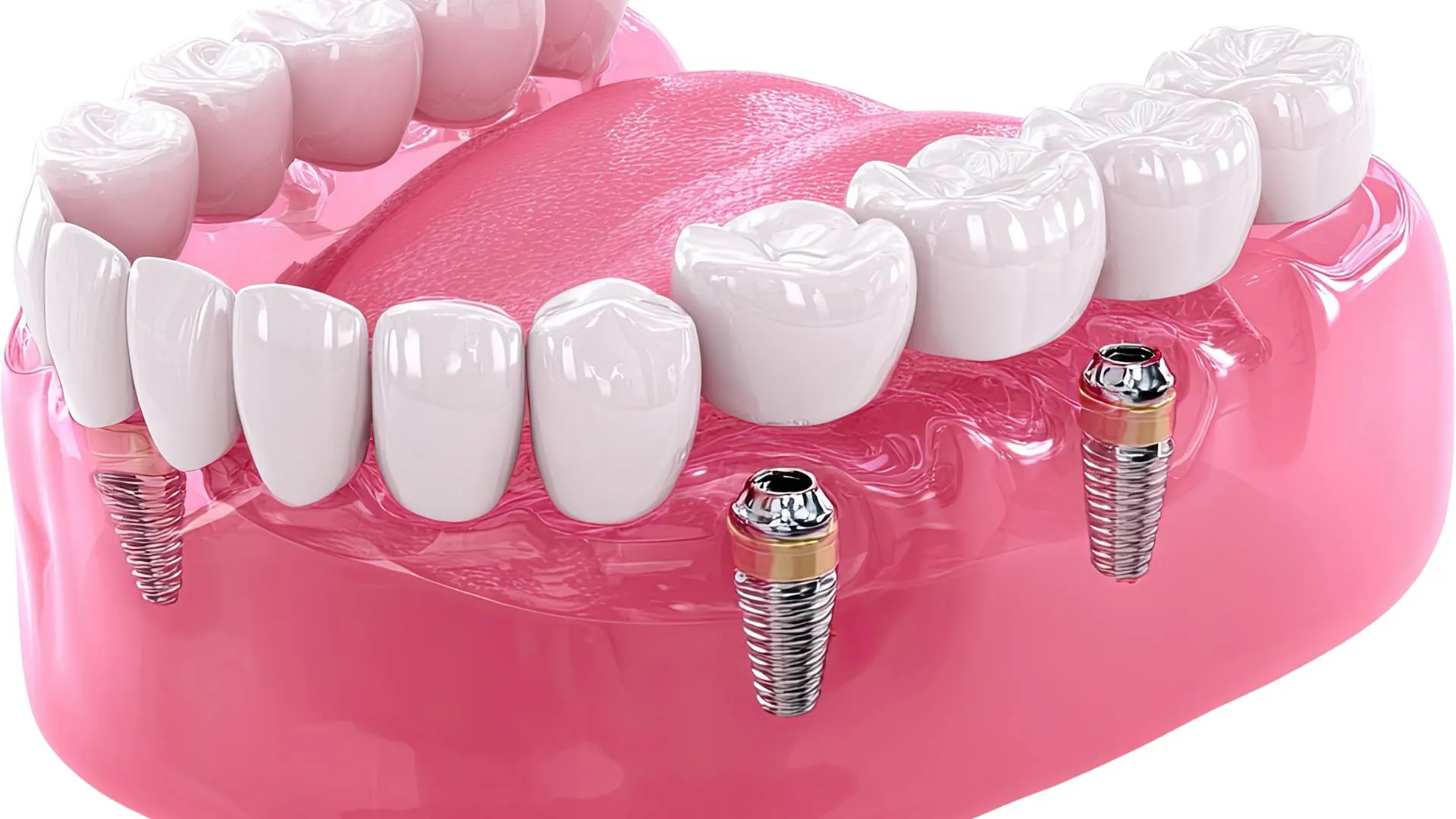
Understanding the All-on-6 Implant Concept
The All-on-6 technique follows a similar philosophy but uses six implants instead of four to support the prosthetic bridge. By adding two additional implants, the restoration benefits from increased structural support and improved distribution of chewing forces.
In the All-on-6 system, implants are placed across the jaw in positions that allow the prosthetic bridge to be supported more evenly. This means that when a patient bites or chews, the forces applied to the teeth are spread across a larger number of implants.
Because more implants are involved, the restoration can sometimes provide greater biomechanical stability, particularly for patients with strong bite forces or larger jaw structures.
However, placing six implants typically requires sufficient bone volume. In cases where bone density is limited, clinicians may recommend the All-on-4 technique instead because it can be performed without additional bone grafting procedures.
Key Differences Between All-on-4 and All-on-6
Although both treatments aim to restore a full arch of teeth using implants, they differ in several important aspects including implant number, load distribution, and overall treatment complexity.
| Feature | All-on-4 | All-on-6 |
|---|---|---|
| Number of implants | 4 implants support the prosthetic bridge | 6 implants support the prosthetic bridge |
| Implant placement | Two vertical implants in front, two angled in the back | Implants distributed more evenly across the arch |
| Bone requirements | Often suitable for patients with reduced bone volume | Requires greater bone density and volume |
| Stability | Highly stable | Increased stability due to additional implants |
| Cost | Generally more affordable | Higher cost due to additional implants |
| Surgical complexity | Slightly less complex procedure | May involve more extensive planning |
Both procedures are designed to provide fixed teeth that function much more like natural teeth compared with removable dentures.
Situations Where All-on-6 May Be the Better Choice
While both procedures are effective, there are certain situations where All-on-6 may provide additional benefits. Because the prosthetic bridge is supported by more implants, the chewing forces can be distributed more evenly across the jaw.
Implant specialists may recommend All-on-6 in cases where:
-
the patient has sufficient bone density to support additional implants
-
the patient has a strong bite force that requires greater structural support
-
long-term load distribution is an important factor in treatment planning
-
the patient prefers the additional reinforcement provided by six implants
In these cases, the extra implants can contribute to increased stability and may reduce the mechanical stress placed on individual implants over time.
Why All-on-4 Is Still One of the Most Widely Used Treatments
Despite having fewer implants, All-on-4 remains one of the most widely used full-arch restoration methods in modern implant dentistry. The treatment was specifically designed to help patients who have experienced significant bone loss.
The angled placement of the posterior implants allows clinicians to anchor implants into stronger areas of bone, often avoiding the need for additional procedures such as sinus lifts or bone grafting.
Another important advantage is that the procedure typically involves fewer implants and therefore may require less surgical time. For many patients, this also translates into lower overall treatment costs while still providing a stable and long-lasting restoration.
Because of these benefits, All-on-4 has become a reliable option for patients who want a fixed full-arch solution without undergoing complex preparatory procedures.
Biomechanics of Implant-Supported Bridges
When chewing or biting, significant forces are applied to the teeth. These forces are transferred through the prosthetic bridge to the implants and ultimately into the surrounding jawbone.
The number and placement of implants influence how these forces are distributed. With four implants, the bridge relies on a carefully designed structure that balances load across the implants. With six implants, the load can be spread across a greater number of support points.
However, advances in implant design and prosthetic engineering have made it possible for All-on-4 restorations to perform extremely well even with fewer implants. The success of the restoration depends more on proper treatment planning and surgical precision than on the number of implants alone.
Success Rates and Longevity
Both All-on-4 and All-on-6 treatments have excellent long-term success rates. Numerous clinical studies show that implant-supported full-arch restorations can achieve success rates above 95 percent when performed by experienced implant surgeons.
Longevity depends on several factors including the patient’s oral hygiene habits, regular dental checkups, and the quality of the prosthetic restoration.
Patients who maintain good oral care and attend routine dental visits can expect their implant-supported teeth to last many years while maintaining comfort and functionality.
Recovery and Healing After Implant Placement
The recovery process after implant surgery is generally similar for both procedures. Patients may experience mild swelling, tenderness, or minor discomfort during the first few days after surgery. These symptoms typically resolve quickly.
During the healing period, the implants gradually integrate with the bone through osseointegration. This process usually takes several months to complete.
In many modern treatment protocols, patients receive temporary teeth shortly after surgery so they can continue eating, speaking, and smiling with confidence during the healing phase. Once the implants have fully integrated with the bone, the final prosthetic bridge is attached.
Cost Differences Between All-on-4 and All-on-6
Cost is another factor that can influence the choice between these treatments. Because All-on-6 involves placing two additional implants, the overall cost of the procedure is usually higher.
However, many patients consider the additional cost worthwhile if it provides greater structural support for their restoration. Others prefer the more cost-efficient All-on-4 option while still benefiting from a stable and fixed set of teeth.
The exact cost of either procedure can vary depending on factors such as implant materials, imaging technology, and the complexity of the surgical treatment plan.
Which Treatment Option Is Best for You?
Choosing between All-on-4 and All-on-6 is not simply a matter of selecting the treatment with more implants. Each patient has unique anatomical conditions that must be carefully evaluated before determining the most appropriate solution.
An implant specialist will typically perform a detailed examination that includes digital imaging and analysis of the jawbone structure. Factors such as bone density, jaw size, bite force, and overall oral health all play an important role in determining which approach will provide the best long-term results.
For some patients, All-on-4 offers an efficient and minimally invasive solution that restores a full smile without requiring additional procedures. For others with stronger bone support, All-on-6 may provide the additional reinforcement needed for long-term stability.
Final Thoughts
Both All-on-4 and All-on-6 represent remarkable advancements in implant dentistry and have transformed the way full-arch tooth replacement is performed. These treatments allow patients who have lost their teeth to regain a stable, natural-looking smile and restore their ability to eat comfortably.
While All-on-6 can provide additional support by using more implants, All-on-4 remains an extremely reliable and widely used solution, particularly for patients with limited bone volume.
Ultimately, the best treatment option depends on careful clinical evaluation and personalized treatment planning. With the guidance of an experienced implant specialist, patients can choose the approach that offers the best combination of stability, durability, and aesthetic results for their smile.